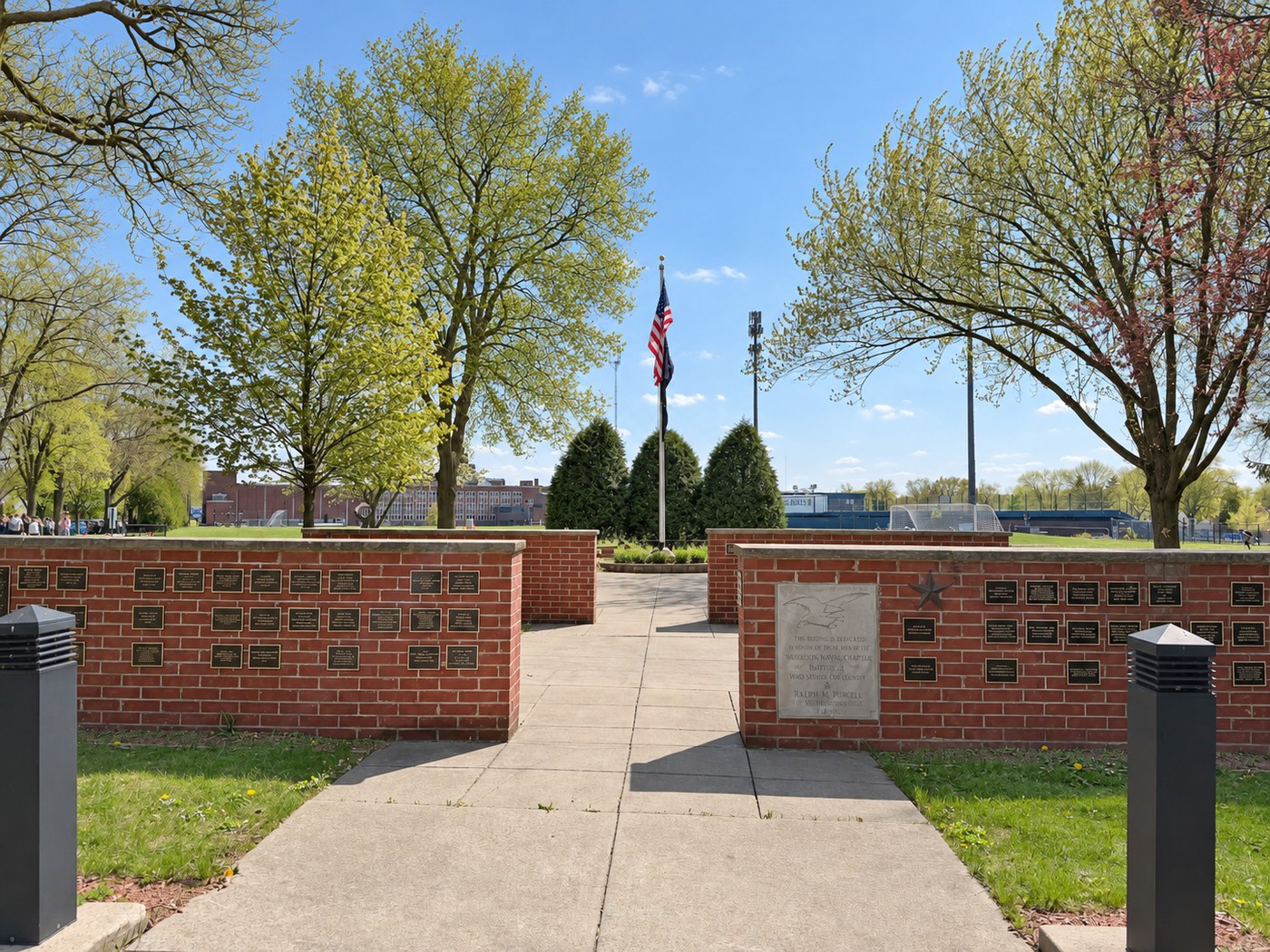
Armory Park and its Veterans Memorial are preserved under the Whitefish Bay School District's current November referendum plan. Voters will consider a $90 million bond proposal that would rebuild and extensively renovate the middle school on its existing site while also funding infrastructure and fire-protection work at other district schools.
The Current Proposal Keeps the Middle School on Its Current Site
The district's current plan would keep the middle school on its existing site, preserve Armory Park and its Veterans Memorial, and combine voter-approved borrowing with $17.9 million from district reserves to address school facility priorities.
Latest Updates
What’s Happening Now
The focus has shifted from the spring debate to the November referendum, the current middle school concept, and what comes next for Armory Park. These are the most relevant recent updates, including a new community endorsement, the latest information session and school tour.
October 9, 2026Community Endorsement
An Endorsement: The Nov. 3 Referendum
Armory Park and its Veterans Memorial remain preserved under the district's revised November referendum plan.The district's current concept shows a rebuilt and extensively renovated middle school remaining on its existing site.
On Nov. 3, our community will return to the polls to vote on a referendum for the second time this year.
We will see a new plan, shaped by concerns, input and priorities from residents on all sides of this issue.
This new plan saves Armory Park and its Veterans Memorial and reduces the request by $45.6 million from the proposal voters rejected in April – while also addressing the top needs of the school district.
This is a direct result of a community sitting down together and finding mutual solutions.
After April, the district held focus groups and gathered more than 2,100 survey responses. It reconsidered the location, redesigned the middle school approach and reduced the cost. The revised proposal reflects a good-faith effort to respond to what residents said.
The proposed investment would give students and educators updated spaces for the everyday work of teaching and learning.
At the middle school, the current concept combines a new classroom wing, a new gymnasium and specialty classrooms with extensive renovation of the historic core. Nearly 70% of the completed building would be new construction, while the oldest portion would be preserved and renewed. The result would be a modern rebuilt school on its existing site.
The proposal also reaches beyond the middle school. At the high school, it would replace failing heating and ventilation systems and improve building infrastructure. Fire-protection and alarm improvements would serve the high school, Cumberland and Richards. These are practical investments in the safety and reliability of buildings students and staff use every day.
Schools depend on dedicated educators, engaged families and facilities that support their work. Maintaining those facilities is a responsibility each generation shares with the next.
The revised plan deserves careful stewardship, clear communication and continued public involvement.
A Community Listening to Each Other
Your involvement produced these updates to the plan. The district's willingness to listen and reconsider also deserves recognition.
“We listened, we redesigned, we prioritized, and we compromised,” School Board member Lynn Raines said during the board’s discussion. Other comments from the board echoed a desire to reflect the needs of the school and the needs of the community together.
The revised plan strikes a reasonable balance: preserving the park and memorial, rebuilding and renovating the middle school, and addressing necessary infrastructure and fire-protection needs across schools.
Residents will continue to have specific questions or concerns about this or any plan. Questions about design, construction and impacts should continue to receive substantive answers. Support and scrutiny can go together.
A yes vote on Nov. 3 can move that work forward. Continued community involvement can help ensure it is done in alignment with all voices at the table.
Community Support
Joint Statement from Whitefish Bay Community Groups
We as Yes to Strong Schools and Save Armory Park jointly endorse the new Whitefish Bay School District referendum on the ballot November 3. This new plan takes a meaningful first step towards addressing the critical needs of our schools while preserving both Armory Park and the Veterans Monument and Memorial Garden. We urge the Whitefish Bay community to join us by coming together to vote “Yes” by November 3.
The new $90 million referendum addresses the most urgent needs of our district while protecting the operational budget that pays for teachers and staff:
New Middle School built on the current site that meets modern educational and accessibility needs (70% new and 30% heavily renovated)
New HVAC at the High School that replaces aging systems well past their planned end of life
Fire safety at both elementary schools and the High School — all four main school buildings will finally have sprinklers
Following the April vote, the district returned to the community through focus groups, meetings, and a survey that drew more than 2,100 responses. After months of listening and dialogue, this revised proposal gives Whitefish Bay an opportunity to chart a shared path forward.
Vote “Yes” by November 3 on the Whitefish Bay School District Capital Referendum (last question on the ballot!).
If you support the revised plan and this joint statement, add your name below. Your email will be used only to confirm your submission and will not be displayed publicly.
Let’s keep learning, asking questions and participating as we work toward the best outcome for our schools and our community.
September 28, 2026Information Session
Whitefish Bay Gives Voters a Closer Look at November School Referendum
The district's second fall information session paired a closer look at the conceptual middle school design with a tour of Whitefish Bay High School — while reminding residents how community feedback reshaped the November proposal.
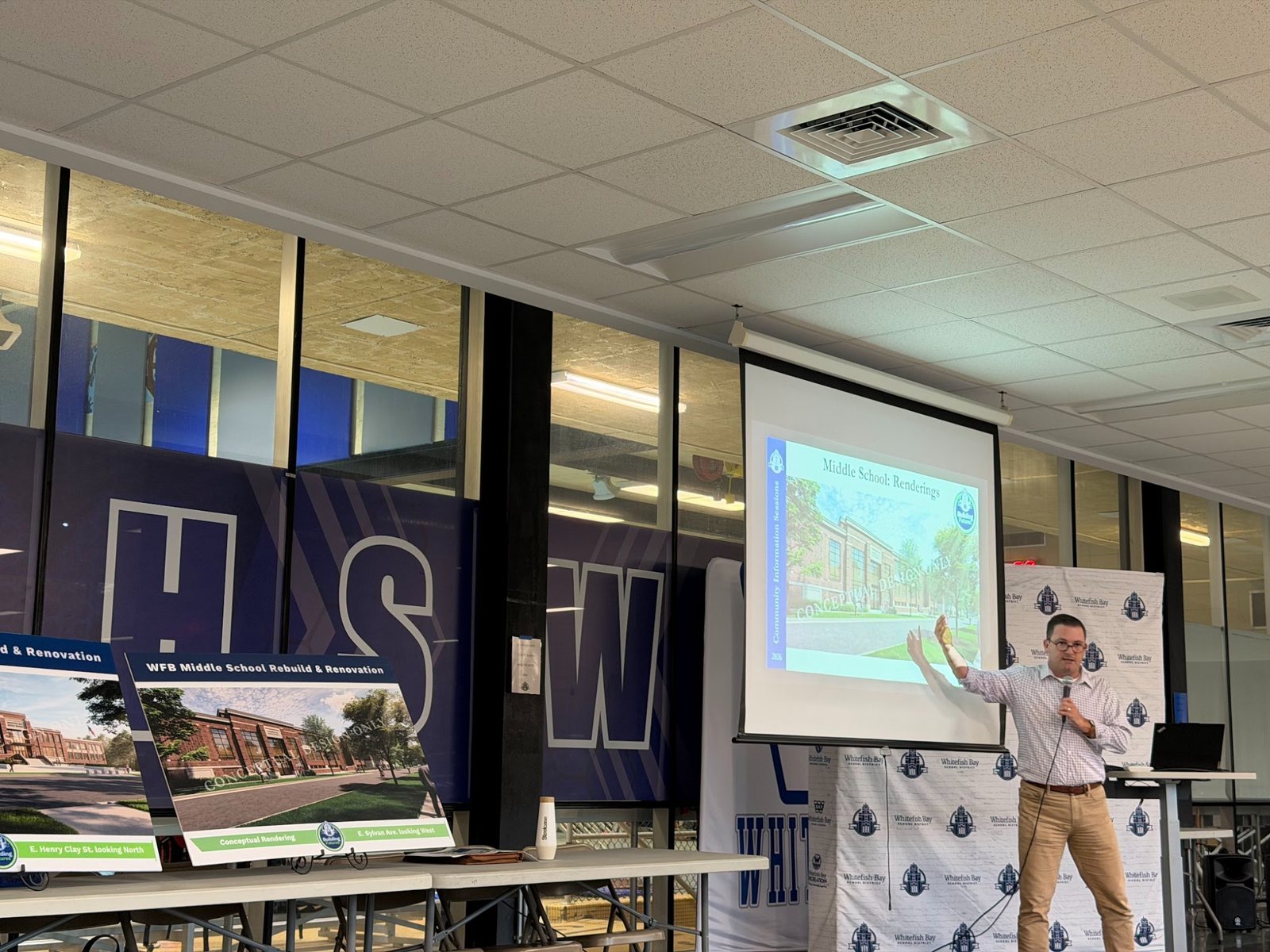
Whitefish Bay residents got another look Monday night at what the district's proposed middle school renovation could become, along with a tour of Whitefish Bay High School. Superintendent Dr. Jamie Foeckler opened the session by reviewing how the district arrived at the November proposal and later led residents through the high school tour.
The Sept. 28 information session at Whitefish Bay High School was the second of four public sessions leading up to the November 3 vote on a $90 million school facilities referendum. The proposal includes rebuilding and extensively renovating the middle school on its current site, major HVAC and fire-protection work at the high school, and fire-protection upgrades at Cumberland and Richards elementary schools. The district also plans to contribute $17.9 million from existing reserves. View the district's referendum overview →
How We Got Here
The presentation also served as a reminder of how significantly the proposal has changed since spring.
In April, voters rejected a $135.6 million referendum that included construction of a new middle school at Armory Park. Afterward, the district returned to the community through focus groups, meetings and a summer survey that drew more than 2,100 responses, along with more than 170 focus-group participants.
According to the district, 86.8% of survey respondents identified the overall cost and tax impact as a reason they believed the April proposal failed. In the district's survey breakdown, 48% of respondents who said they voted no identified the proposed Armory Park location as one of the primary reasons for their vote.
The result was a substantially different November proposal: borrowing was reduced by $45.6 million, land acquisition was removed from the plan, and the middle school proposal shifted back to the existing school site.
More Detail This Time Around
Another theme from the community feedback was a desire to better understand what the district was actually proposing to build.
Architect Nick Kent of Plunkett Raysich Architects told residents Monday that one of the messages the design team heard after the first referendum was that the community wanted to see more of what the middle school “would be or could be.”
That helps explain why the district is now showing voters considerably more than it did before the April vote.
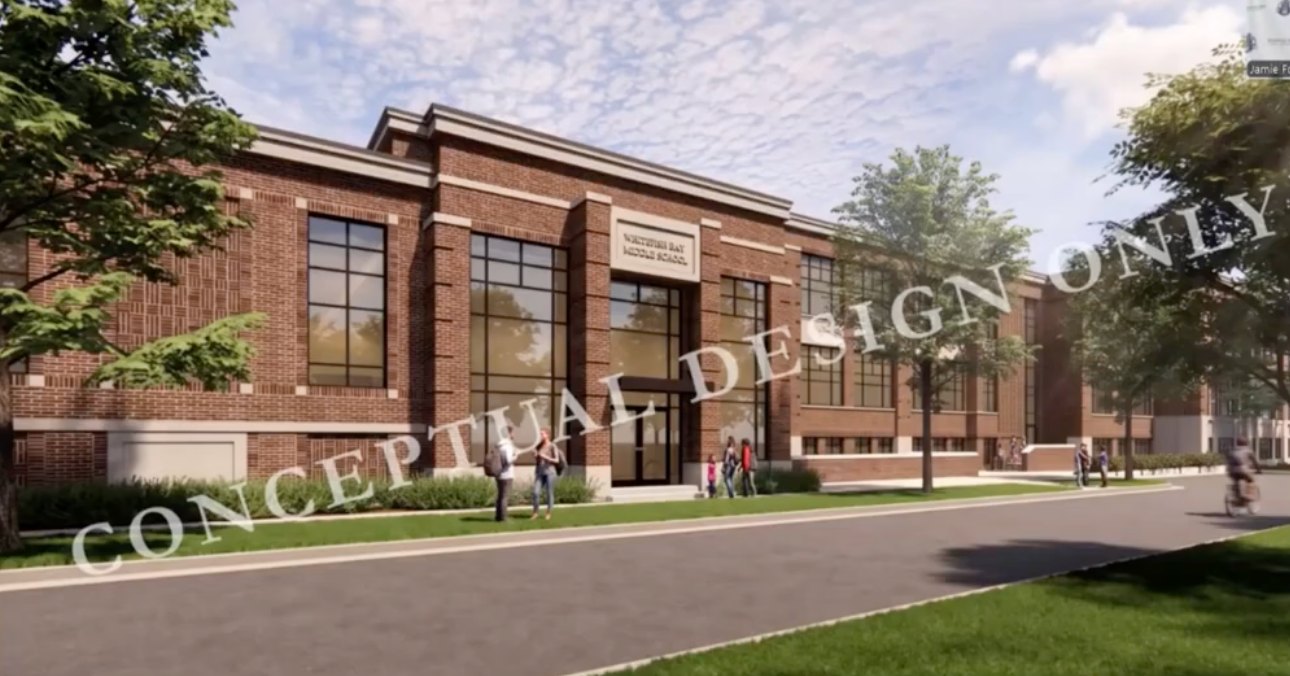
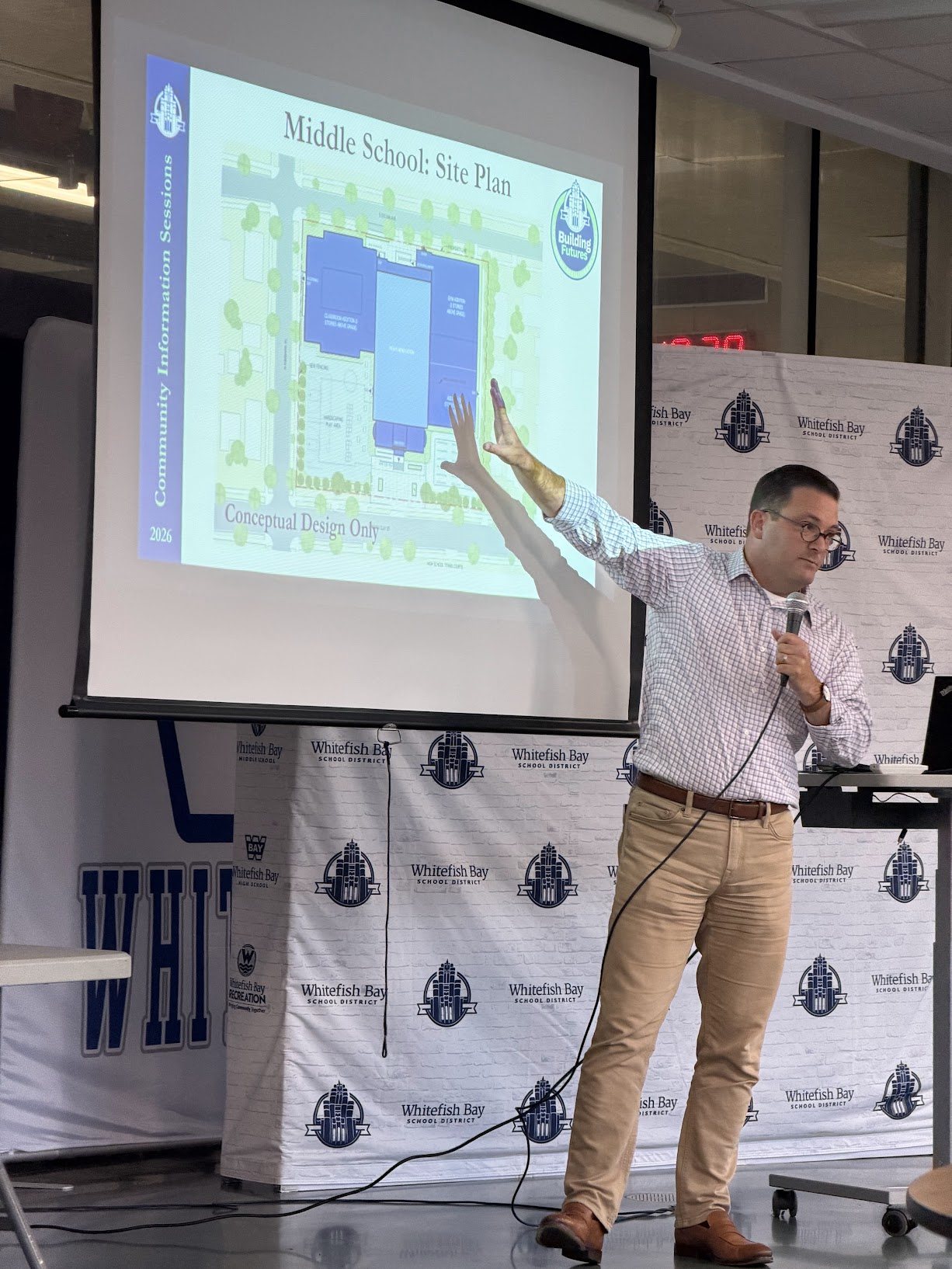
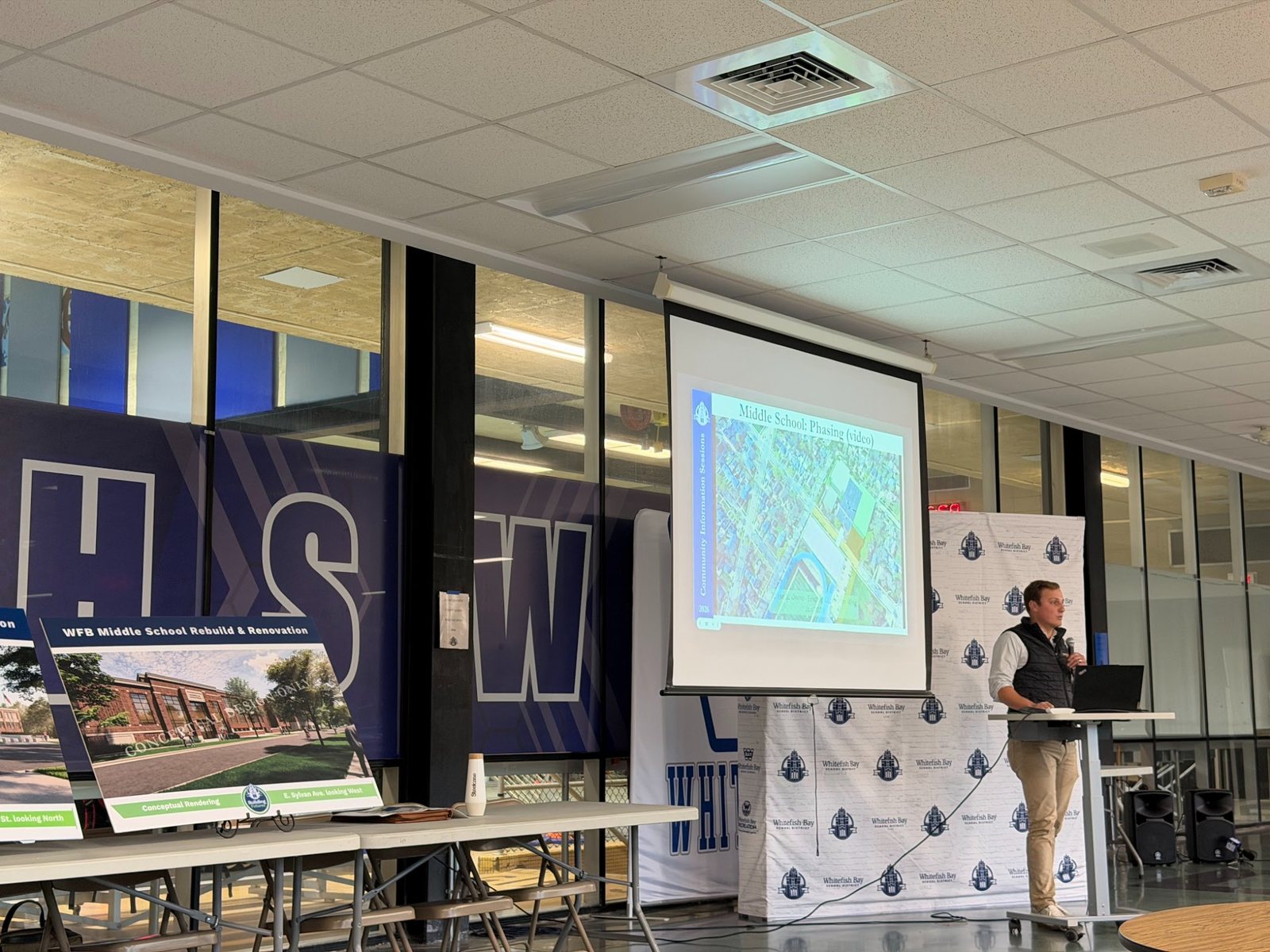
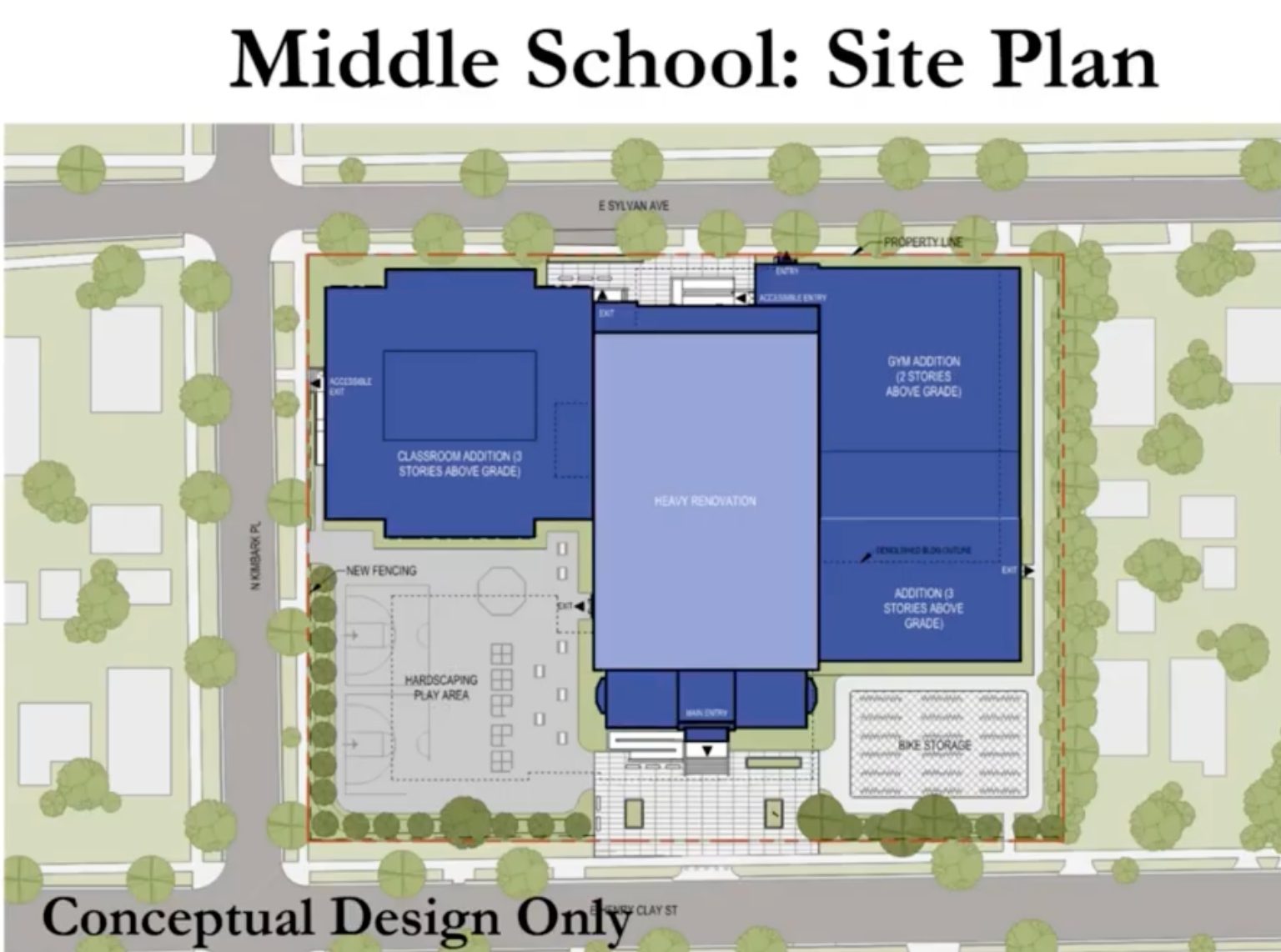
Monday's presentation included a preliminary site plan, floor plans, exterior renderings and construction-phasing concepts. The district continues to emphasize that each is “Conceptual Design Only.” If voters approve the referendum, the detailed design process would continue with input from staff, students and community members before final construction documents are produced.
The conceptual site plan was among the preliminary design materials shown to residents.C.D. Smith walked through how construction could be phased while school remains in session.
Under the current concept, the oldest surviving portions of the middle school — dating to 1918 and 1924 — would remain and receive extensive renovation. A new three-story classroom wing would be built on the west side, while a new gymnasium and specialty-space wing would eventually replace the existing east classroom wing.
Kent said the historic center of the school could become a student commons and gathering space, while new classrooms would remain enclosed but connect to smaller collaborative and breakout areas.
How Construction Could Work
C.D. Smith also walked residents through how the middle school could remain operational during the multi-year construction project.
The current plan begins by constructing the new classroom wing on the west side of the property. Students would then move into the completed classrooms, allowing the existing east classroom wing to be demolished and replaced with the new gym and specialty spaces.
Renovation of the historic central portion would follow, with final entrance and site work completing the project around early 2031.
Construction manager C.D. Smith said work zones would be physically separated from students and staff, with fencing, controlled access, air-quality monitoring and disruptive work scheduled around school operations when possible.
Touring the High School
Monday's event also included a tour of Whitefish Bay High School.
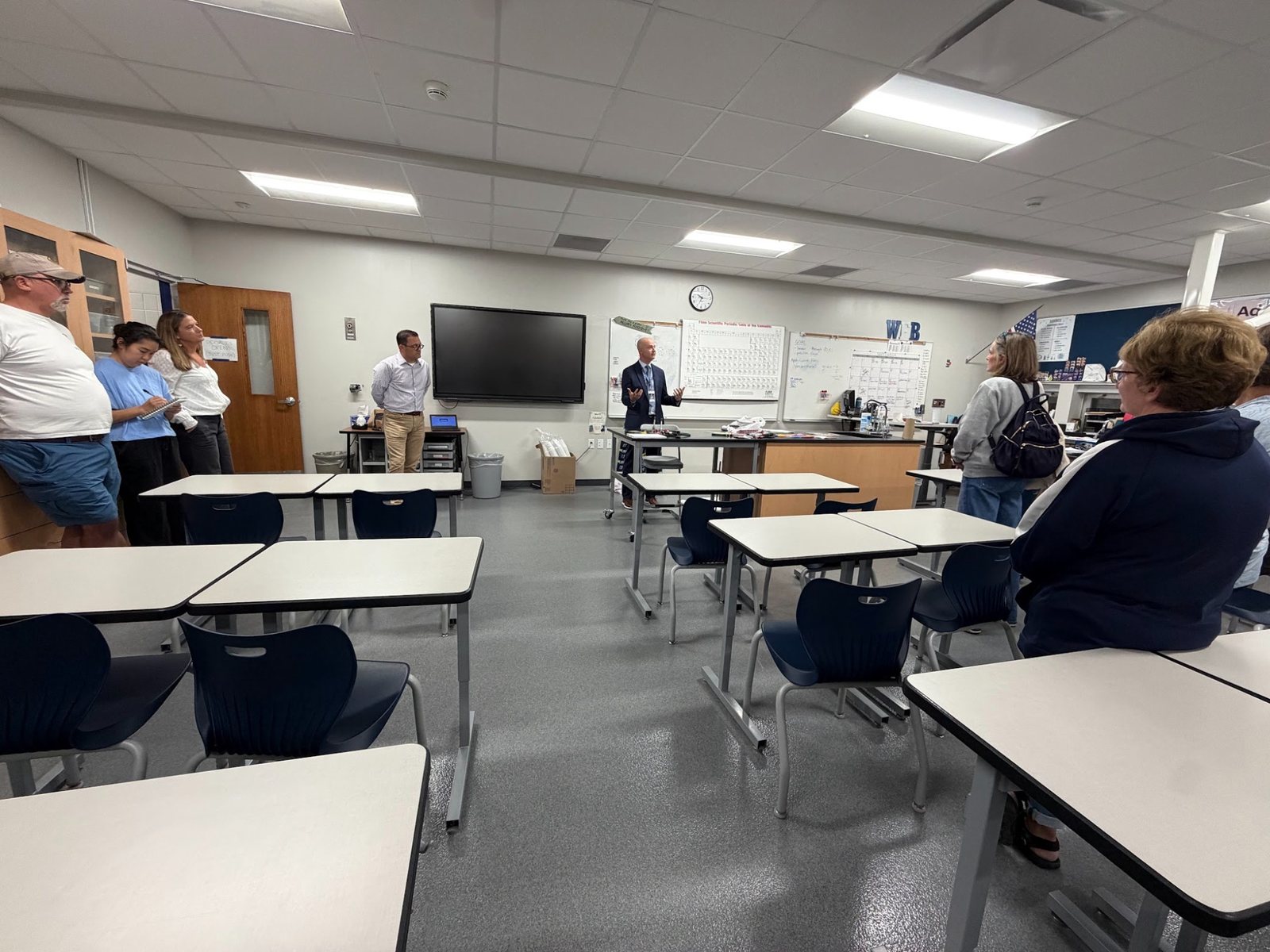
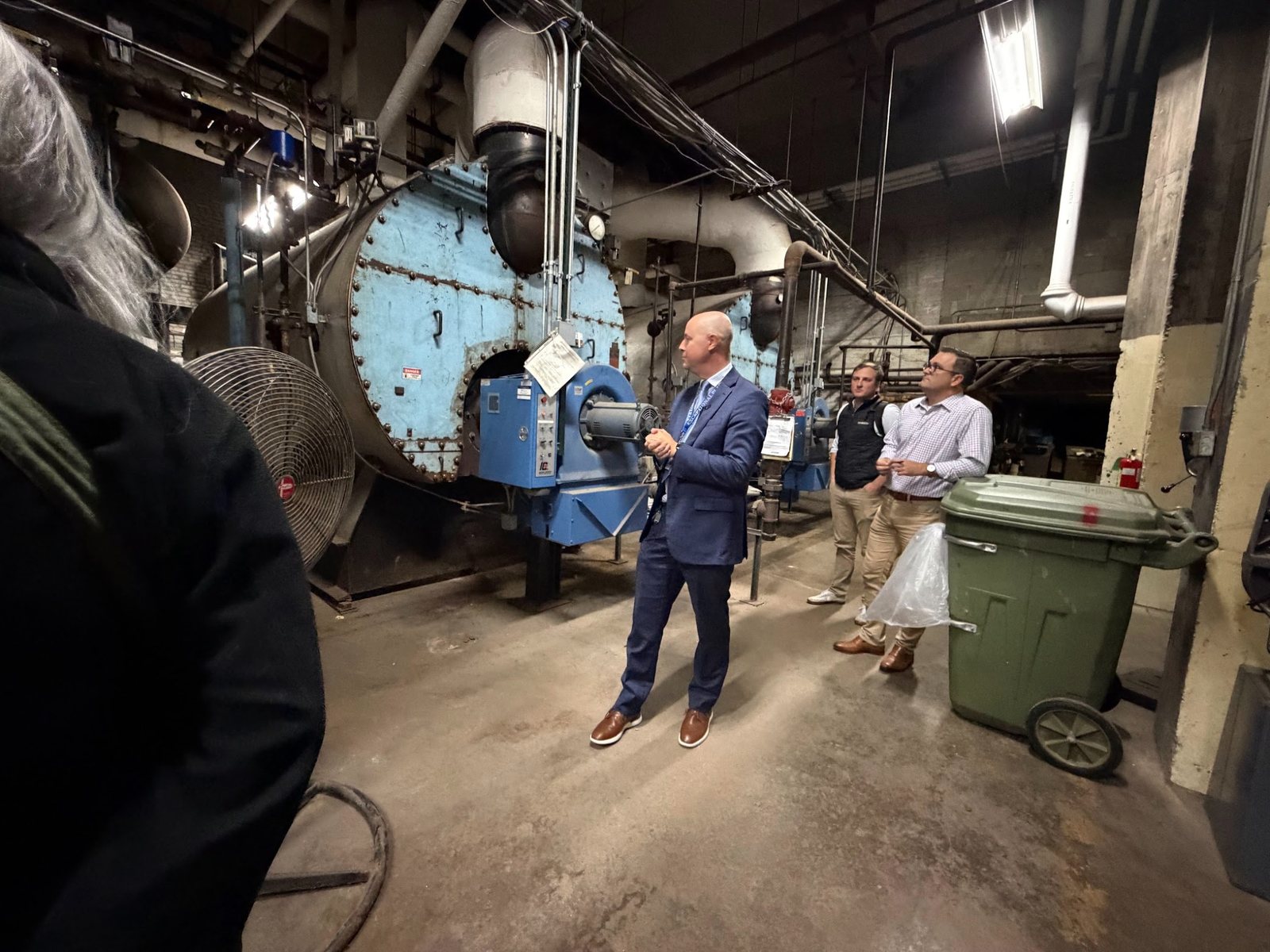
Residents saw recently renovated science and business classrooms alongside older spaces that still rely on aging heating and ventilation equipment. District officials explained that the proposed high-school work would replace the existing steam-based HVAC infrastructure with a modern system rather than continuing to replace individual components piecemeal.
The high-school tour compared updated learning spaces with areas still served by older building systems.The tour included the high school's existing mechanical equipment, part of the infrastructure work included in the referendum proposal.
The tour also stopped in the auditorium, where officials said an old air-conditioning system is no longer functional and replacement parts are obsolete. Much of the proposed high-school mechanical work would be completed over three summers to limit disruption during the school year.
Two More Chances to Take a Look
Two additional information sessions remain before Election Day:
Thursday, October 15 at 6 p.m. Whitefish Bay Middle School Gym
Monday, November 2 at 6 p.m. Whitefish Bay Middle School Gym
District Shows What the Rebuilt Middle School Could Look Like
At the first community information session, the district shared exterior concepts, floor plans and a four-phase construction sequence for a roughly 144,000-square-foot middle school on the current site. The plans are conceptual; detailed design would follow if voters approve the referendum.
One recurring question after the April referendum was what residents would actually be getting for the investment. The district's September information session gave the community a more concrete look at the current middle school concept through site plans, floor plans, exterior renderings and construction phasing.
The district describes the proposal as a functionally “like new” middle school built on the existing site. The current concept totals approximately 144,000 square feet: about 98,000 square feet of new construction and 46,000 square feet of extensive renovation. Approximately 81,000 square feet of the existing facility would be demolished.
The oldest surviving portion of the middle school would remain and be heavily renovated. New construction would include a west classroom wing and an east gymnasium/specials addition. The final building would not extend farther north than the current school, although it would extend farther west.
Conceptual now; detailed design later
The district is emphasizing that the current drawings are concepts, not final construction documents. If the referendum is approved, detailed architectural design, engineering, documentation and permitting would follow before construction begins.
Four construction phases
The current phasing plan starts with a new classroom wing, then shifts students into that space before the existing east classroom wing is removed and the gymnasium/specials addition is constructed. A heavy renovation of the historic core would follow, with the new main entrance and final site work completing the project.
Phase 1: West classroom wing — December 2027 to December 2028
Phase 2: Gymnasium and specials addition — December 2028 to December 2029
Phase 3: Heavy renovation of common areas and central core — December 2029 to August 2030
Phase 4: Remaining demolition, south elevation, main entrance and site work — March 2030 to January 2031
The district says no temporary classrooms are anticipated during Phases 1 and 2. Phase 3 is expected to require temporary classrooms and a temporary cafeteria. Outdoor play space would be reduced during the early construction phases, with additional outdoor provisions needed at the high school site.
Where to review the district's materials
The district has posted its middle school renewal materials, referendum overview, tax information and information-session schedule at wfbreferendum.org. The next information sessions are scheduled for September 28, October 15 and November 2.
August 20, 2026Referendum Update
School Board Approves November Referendum Plan That Preserves Armory Park
The Whitefish Bay School Board has approved a $90 million referendum for the November 3 ballot that rebuilds the middle school on its current site. Board members said the revised plan reflects what they heard after April about cost, Armory Park and a preference to reconsider renovate-in-place.
The Whitefish Bay School Board has officially approved a new $90 million facilities referendum for the November 3, 2026 ballot — with the middle school remaining on its current site and Armory Park preserved.
In July, the Friends of Armory Park issued a statement asking the district to preserve Armory Park and the Veterans Monument and Memorial Garden while finding another path for the middle school. After the board moved toward rebuilding on the existing school site, the group issued a subsequent statement saying, “We, the Friends of Armory Park, support this plan.” The statement is preserved here as part of the site's record of the process. For a closer look at the proposed rebuild-in-place design and phasing, see the August renovation presentation and recap.
The change from the April referendum followed months of community feedback. After the $135.6 million proposal failed, the district conducted a new community survey with more than 2,100 participants and four focus groups involving more than 170 residents. Board members said the feedback pointed to two major concerns: the overall cost of the proposal and opposition to building the new middle school in Armory Park.
The district's published survey summary says 86.8% of respondents identified the April proposal's total cost and tax impact as a reason they believed it was not approved. In the district's survey breakdown, 48% of respondents who said they voted no identified the proposed Armory Park location as one of the primary reasons for their vote. The district also reports weighted support of 57.5% for a $90 million project and 44.7% for a $95 million project.
The School Board ultimately selected the $90 million bond amount and a middle school concept that remains on the existing school property.
The board has now approved both the $90 million bond resolution and the resolution placing it before voters. The legal referendum language specifically calls for additions, renovations, partial removal and site improvements at the middle school “on its current site.”
Community feedback changed the direction
During the discussion before the vote, several board members spoke directly about how the community response affected their thinking.
“The one thing that came as a surprise, however, was the opposition to the Armory site and the preference for renovate in place.”
— Kristin Bencik-Boudreau, School Board President
Bencik-Boudreau said the board had initially believed opposition was concentrated largely among neighbors and people with close ties to Armory Park.
“Prior to the community survey and the focus groups, I felt there was only a small minority of residents who opposed the site — the neighbors directly affected, and those who had close ties to the Armory,” she said.
The survey and focus groups demonstrated something different.
“However, as the survey showed us, 48.65% of those who voted no did so because of the location of the proposed middle school,” Bencik-Boudreau said. “The focus groups with Friends of Armory also clearly detailed there was simply no support for changing the Armory site, and there would actually be an active campaign against it.”
“We listened. We redesigned. We prioritized.”
Raines offered one of the clearest summaries of why she supports the new proposal.
“For me, the rationale comes down to three things: we listened, we redesigned, and we prioritized.”
— Lynn Raines, Whitefish Bay School Board
“We listened to the referendum result, concerns about the level of investment, and residents who asked us to take another serious look at renovating the middle school,” Raines said.
She emphasized that the new proposal is not simply a return to an earlier renovation concept. Architects substantially redesigned both the building and the construction process so a new three-story classroom wing could be completed first. Students could then move into those classrooms before major work begins on the rest of the building.
“The resulting approach fundamentally changed the plan,” Raines said.
She also addressed Armory Park directly: “We also took another serious look at Armory Park. For me, that evaluation reinforced a fundamental concern. Armory Park is not district-owned land. The hurdles and uncertainties that remain, and our reliance on circumstances outside the district's control, are simply too significant for me to view it as a viable path forward.”
At the same time, she said the new approach gives the community the opportunity to create an essentially new school on the existing site. “While we call this a renovation, the finished product will essentially be a new middle school.”
Raines concluded: “We listened, we redesigned, we prioritized, and we compromised. Compromise does not mean abandoning our goals as a board. It means finding a responsible path forward toward them that our community can move forward on together.”
Sandy Saltzstein: “I had underestimated” what the land meant to people
Board member Sandy Saltzstein, who participated in the district's Facilities Advisory Committee process, spoke candidly about how her understanding of Armory Park changed during the process.
“I certainly came to understand through this process that I had underestimated people's real, genuine, emotional feelings about that land and what it has come to mean over time.”
— Sandy Saltzstein, Whitefish Bay School Board
She described that as an important piece of information the board did not fully appreciate during its initial discussions.
“I think that was an important piece of understanding that developed through the process that I don't think we had when we had our initial conversations.”
Saltzstein said she now believes the district has reached a good solution and expressed enthusiasm about the middle school floor plan and the opportunity to move ahead without using the park. “I think we've gotten to a good place here,” she said.
A substantially new middle school — on the existing site
Although the district continues to use the term “renovation,” the scope of the middle school project is extensive.
Architect Nicholas Kent explained that construction would begin with a new three-story classroom wing on the west side of the current school. That sequencing is critical: students would be able to move into permanent new classrooms before the existing eastern classroom wing is removed.
A new gymnasium and specialty classrooms would then be constructed on the east side. The oldest portion of the school would be substantially transformed while preserving some of its historic architectural features. The former gym and stage would become a central commons and gathering space, with the existing architectural details incorporated into the new design.
The current front portion of the building would eventually be removed and replaced with a new entrance, new facade and fully accessible routes into the school.
“Every system will be new. Virtually every finish in this building will be new. It will be a new building.”
— Nicholas Kent, PRA
Superintendent Dr. Jamie Foeckler told the board that administrators believe the redesigned phasing makes the project workable educationally. Because the classroom wing would be constructed first, the academic core of the school day could continue in permanent classrooms while subsequent phases are completed.
District plans to continue answering community questions
Dr. Foeckler also highlighted another lesson the district plans to carry forward from the April referendum: giving residents opportunities to ask detailed questions and receive direct responses from the district and its project team.
He said the district received particularly positive feedback about how responsive it was to questions during the previous referendum process. More than 130 questions were submitted over roughly two months, and the district used a process that routed questions to the appropriate team members and generally produced responses within several days.
“We felt like that was very effective,” Foeckler said. “Got very good feedback from community members, both at personal sessions and also just feedback and a thank you and an email back from a response. So we're going to keep all of that the same.”
The district plans to bring back that question-and-answer format along with updated FAQs, community information sessions, online resources and additional materials explaining the new proposal.
Foeckler also said the district understands that residents will want to know why the proposal changed so substantially between April and November.
“We're prepared to tell that story,” he said, pointing to the survey and focus-group results as important evidence in explaining where the district was, where it is now and where it is going.
What the $90 million referendum includes
The November proposal is broader than the middle school. The approved resolution includes:
Extensive rebuilding and renovation of Whitefish Bay Middle School on its current site
Major HVAC, mechanical and infrastructure replacement at Whitefish Bay High School
Fire-protection and fire-alarm improvements at Whitefish Bay High School, Cumberland Elementary School and Richards Elementary School
Related furnishings, fixtures and equipment
The board was also transparent that $90 million will not address every facility need identified through the district's planning process. Elementary-school HVAC, accessibility, security and other projects remain, and board members discussed developing a clearer long-term facilities roadmap so residents understand what could need to be addressed in future years.
How the November proposal differs from April
The April referendum proposed a new middle school on the Armory Park site as part of a $135.6 million bond request. The November proposal instead calls for rebuilding and renovating the middle school on its current property and authorizes up to $90 million in bonds, with an additional $17.9 million proposed from district reserves for the overall facilities program.
The November ballot therefore presents voters with a materially different facilities package. Armory Park and the Veterans Memorial are not proposed as the middle school construction site under the current concept.
The next decision belongs to Whitefish Bay voters on November 3, 2026.
August 2026Statement
An Update from the Friends of Armory Park
"We, the Friends of Armory Park, support this plan." After the school board voted to place a renovate-in-place referendum on the ballot, the group that asked the district to preserve Armory Park and the Veterans Monument responds.
This summer, the Friends of Armory Park released a statement asking the Whitefish Bay School District to pursue a Middle School plan that preserves Armory Park and the Veterans Monument and Memorial Garden. We asked the district to consider renovating the existing school or building at an alternative site, rather than displacing this memorial.
The district has now put forward a new plan: Rebuilding the Middle School in place, creating a fully new and modern building without displacing students, while preserving Armory Park.
We want to answer clearly again. We, the Friends of Armory Park, support this plan.
"We want to answer clearly again. We, the Friends of Armory Park, support this plan."
This is the outcome we asked for. It modernizes our schools, and it leaves Armory Park and the Veterans Monument and Memorial Garden exactly where they belong, on the ground that has held this history since 1908. The men and women who trained here and served are honored here, where the garden, the trees, and the Red Arrow Division memorial were placed with intention. This plan means they can stay as they were meant to be.
We are grateful that the district listened, and we are grateful to every neighbor who signed our statement, showed up to meetings, and made this outcome possible for our community.
Signed,
Bill Miesel Caretaker, Veterans Monument and Memorial Garden at Armory Park
Hospital Corpsman (FMF), U.S. Navy 1979–1983
Captain, U.S. Army (Retired) 1983–1993
Ellen Abrams Blankenship Co-founder, Veterans Monument and Memorial Garden at Armory Park
Sister of Lt. John Abrams, Whitefish Bay High School class of 1958, KIA in Vietnam in 1968
David Kurtz Co-founder, Veterans Monument and Memorial Garden at Armory Park
Past State Commander and Adjutant of The American Legion
Former Chief Warrant Officer, US Army
Dan Carey Former Captain, U.S. Army
Memorial Day Ceremony Founder and Organizer
Anoop Prakash Whitefish Bay Memorial Day Committee
Former Captain, US Marine Corps
James Gomez Whitefish Bay Resident
Former Major, US Marine Corps
August 12, 2026Board Meeting Recap
Major Turning Point: School Board Backs Middle School Plan That Protects Armory Park
During its August 12 facilities-planning meeting, board members expressed broad support for rebuilding the middle school on its existing site rather than constructing a new school in Armory Park. No final referendum plan has been approved, but the direction represents a major shift.
During its August 12 facilities-planning meeting, board members expressed broad support for rebuilding the middle school on its existing site rather than constructing a new school in Armory Park.
The direction expressed by the board represents a major shift from the proposal voters considered in April — and an important moment for everyone who has worked to protect the park, its green space and the Veterans Memorial.
The community was heard
Superintendent Dr. Jamie Foeckler began the discussion by reviewing feedback gathered through community focus groups, meetings with middle school neighbors, conversations with the Veterans Memorial and Armory Park work group, survey responses and emails.
One of the themes identified during the June 16 focus group was that "a significant number of participants cited the lack of trust stemming from the vague architectural plans and proposed utilization of Armory Park, which many see as a beloved historical area and green space."
Dr. Foeckler noted that similar themes appeared across several forms of community engagement. The district also heard substantial support from neighbors and focus-group participants for renovating or rebuilding the middle school in place.
That feedback was especially clear during a July 20 session involving 21 members of the Friends of Armory Park and the broader community. The district's focus-group feedback summary identified preservation of Armory Park and the Veterans Memorial as the strongest and most consistent theme.
Participants described the park as historic, sacred and irreplaceable. They rejected incorporating the Veterans Memorial into a middle school campus and urged the district to pursue a rebuild-in-place option that would leave both the memorial and the park intact.
Community members attended meetings, participated in focus groups, completed surveys, wrote emails and spoke directly with board members about why the park cannot be treated as an empty construction site. Those efforts made a difference.
School Board member Brett Christiansen said those conversations gave him what he described as a more firsthand understanding of how the community views the proposed use of Armory Park.
"We don't have the support that we thought we did for building over Armory Park," he said. "So I'm definitely not in favor of building on Armory Park right now."
"We don't have the support that we thought we did for building over Armory Park. So I'm definitely not in favor of building on Armory Park right now."
— Brett Christiansen, Whitefish Bay School Board
A substantially new middle school on the existing site
The alternative presented to the board is much more extensive than a conventional renovation. Under the preliminary concept, roughly 70% of the completed middle school would be new construction — about 98,000 square feet of new space alongside 45,000 square feet of heavily renovated space.
The plan would preserve and extensively renovate the historic core of the original Henry Clay School, turning the historic interior gym into a student commons and cafeteria. New space for music, student services, special education and administration would be added, and the building's mechanical and other major systems would be replaced along with improvements to accessibility, security, restrooms and circulation.
Nicholas Kent of PRA Architects told the board that the completed project would be "functionally a new building."
The historic portion would be stripped to its structural core, restored and equipped with new systems. The current estimated cost of the middle school concept is $68.4 million.
Students could remain on campus
Concern about displacing students was one of the primary reasons the district previously moved away from renovating the existing school. The new plan addresses that through a phased construction process lasting roughly three years.
The district would build the new classroom wing first. Students would move into those permanent classrooms while the existing eastern wing came down and the new gym, specialized classrooms and administrative areas went up. Later phases would renovate the historic center of the school and finish the entrance, plaza and site work.
The new plan is designed to avoid moving students into trailers or busing them to another campus.
Preserving history while building for the future
The concept would preserve the historic heart of the original Henry Clay School while replacing much of the outdated building around it.
The former gymnasium in the oldest section of the building could become a new student commons and cafeteria. The preliminary design would bring natural light into the space, recognize its remaining architectural details and potentially restore a small platform for performances and assemblies.
Kent described the commons as one of the most exciting parts of the proposal: "This could be really quite a compelling story to tell about bringing new uses to the oldest remaining piece of infrastructure in the school district over a century later."
School Board member Lynn Raines said the approach reflects Whitefish Bay's identity while preserving the historical character of the district's first school: "This option is able to provide an intersection of a tight-knit school community campus — as the Whitefish Bay community is — while maintaining the historical character of our first building."
Raines also highlighted the possibility of opening the new gym and commons to community activities: "There's a lot of joy in getting the community around a building that's more accessible — being able to provide tournaments or things in the commons that the community would want to use the space for."
She said she was especially pleased that the phased plan would allow students to remain at the middle school: "I'm really pleased that we can keep kids in the building without putting them in trailers or having to transport kids across town. I'm also in favor of renovating in place."
Broad board support for rebuilding in place
As the discussion continued, board members were asked directly whether they favored constructing a new school in Armory Park or rebuilding the middle school on its current site.
The response was strikingly consistent.
Multiple board members supported keeping the middle school on school-owned land. They cited the ability to protect Armory Park, avoid a land exchange, preserve the historic school structure, maintain the shared middle school and high school campus, and minimize disruption to students.
One board member said the approach might be the option that is "least divisive for the community" because it could provide an excellent educational facility without affecting the Veterans Memorial or green space.
Christiansen described the rebuild-in-place proposal as "much superior" and expressed hope that protecting Armory Park would create broader community support for the other school projects the district needs to complete.
Another board member said the proposal "dramatically simplifies" what the district must explain to voters. The district would no longer need to justify what would happen to the park's green space and trees, while the phased plan would avoid putting students in temporary classrooms.
What could be included in a new referendum?
The board also discussed a possible referendum package: the $68.4 million middle school project, a full mechanical-system replacement at the high school, and fire-alarm and fire-protection improvements at the high school and elementary schools. The preliminary total is roughly $107.8 million, and the district has identified about $17.8 million in existing local funds it could contribute — bringing the borrowing request to approximately $90 million.
No final amount was selected. Some board members favored staying near $90 million, while Christiansen suggested a figure between $100 million and $115 million could let the district complete additional work and benefit from construction efficiencies.
The board also recognized that residents need to know exactly what they would receive at each potential referendum amount. Christiansen said that when tax tolerance came up during the focus groups, residents told him they could not choose a responsible dollar amount without knowing which projects would be included: "People had broad concerns about affordability. But in terms of assessing what an appropriate dollar amount was, it really came down to people wanting to know what they were getting for it."
The board is expected to take a formal vote on the referendum question at its next meeting.
Progress worth recognizing
For months, residents have argued that Whitefish Bay should not be forced to choose between supporting excellent schools and protecting Armory Park.
The August 12 discussion shows that there may be another path: a substantially new middle school that meets modern educational needs, preserves the historic heart of the original school, keeps students on campus and leaves Armory Park and the Veterans Memorial intact.
The people who attended meetings, organized, wrote letters, displayed signs, completed surveys and spoke with their neighbors helped change the conversation.
Save Armory Park appreciates the board members and district staff who listened and developed an alternative that appears capable of serving students without sacrificing this irreplaceable public space.
For now, this is a major turning point, and one the entire community helped make possible.
Forward-Looking Questions
November Referendum FAQs
These questions focus on the proposal voters will consider now. For the district's complete FAQ and official referendum materials, visit wfbreferendum.org/faqs.
Is the district still proposing a middle school at Armory Park?
No. The November proposal rebuilds and renovates the middle school on its current site. Armory Park is not the proposed school site.
What happens to the Veterans Memorial?
The current middle school concept does not require relocating the Armory Park Veterans Memorial for school construction. The park and memorial remain in their current setting under the proposal.
Is this a renovation or a new school?
It is a combination. The current concept includes approximately 98,000 square feet of new construction and 46,000 square feet of extensive renovation, creating a roughly 144,000-square-foot middle school. Nearly 70% of the completed building would be new construction.
Are the renderings and floor plans final?
No. The district describes the current drawings as conceptual. They show the proposed configuration and project direction. Detailed architectural design, engineering, documentation and permitting would follow if the referendum is approved.
How would construction work with students still in the building?
The project is planned in four phases. A new west classroom wing would be built first, allowing students to move into that space before later demolition and construction. The district says no temporary classrooms are anticipated in Phases 1 and 2; Phase 3 is expected to require temporary classrooms and a temporary cafeteria. Construction is currently shown running from late 2027 into early 2031.
What construction impacts should neighbors and families expect?
The district's current materials say exterior play space would be significantly reduced during the first two phases, with additional outdoor play provisions needed at the high school site. More detailed traffic, staging, pedestrian-routing and site-safety plans would be developed as design and construction planning advance.
What does the $90 million bond pay for?
The overall facilities program includes a $68.4 million middle school project, $35.5 million in high school infrastructure, maintenance and fire-protection/alarm work, and $4 million in fire-protection/alarm work at Cumberland and Richards. The district proposes using $17.9 million from reserves so the bond authorization is capped at $90 million.
How did community feedback affect the November proposal?
After April, the district hosted focus groups and conducted a summer survey with more than 2,100 participants. The district reports that 86.8% of respondents identified total cost and tax impact as a reason they believed the April referendum was not approved. In the district's survey breakdown, 48% of respondents who said they voted no identified the proposed Armory Park location as one of the primary reasons for their vote. The School Board ultimately advanced the current-site middle school concept and a $90 million bond question.
Where can I see the concepts and ask questions?
The district has posted middle school concepts, tax information and referendum materials at wfbreferendum.org. Remaining community information sessions are September 28 at Whitefish Bay High School, October 15 at the Middle School Gym and November 2 at the Middle School Gym, all at 6:00 p.m.
📅 November 3, 2026
Referendum Voting & Information
🗳️
Election Day · Tuesday, November 3, 2026
Polls are open from 7:00 a.m. to 8:00 p.m.
District residents will vote on a general-obligation bond issue not to exceed $90 million.
Check registration, polling-place and absentee-voting information at MyVote Wisconsin. The district also maintains voting information at wfbreferendum.org/vote.
Upcoming District Information Sessions
Community members can attend an upcoming district session to review the facility challenges, hear the referendum presentation, tour the site, and participate in a question-and-answer session. Recordings are published online after sessions are held.
What Changed — and What Voters Are Considering Now
The November referendum is materially different from the proposal considered in April. The middle school would remain on its existing property, Armory Park and the Veterans Memorial would remain in place, and the total bond authorization would be capped at $90 million. The district would also use $17.9 million from existing reserves toward the overall facilities program.
🏫
Middle school stays on the current site
The district's current concept combines approximately 98,000 square feet of new construction with 46,000 square feet of extensive renovation. The finished building would total about 144,000 square feet, with nearly 70% new construction.
🌳
Armory Park remains a park
The current plan does not place the middle school in Armory Park and does not require relocating the Veterans Memorial for the school project. The park's mature trees, memorial setting and community green space remain outside the proposed school construction footprint.
🏛️
Historic portions of the middle school remain
The oldest surviving section of the school would be preserved and extensively renovated. Later phases would renovate the historic core and restore the south elevation while new classroom, gymnasium and specials spaces are built around it.
🚧
Construction would be phased while school remains in session
The current sequence runs from late 2027 into early 2031. New classroom space would be built first so students can move into permanent rooms before later demolition and renovation. Temporary classrooms are not anticipated in the first two phases; Phase 3 is expected to require temporary classroom and cafeteria space.
💵
$90 million in bonds plus district reserves
The proposed facilities program includes $68.4 million for the middle school, $35.5 million for high school infrastructure, maintenance and fire-protection work, and $4 million for fire-protection and alarm work at Cumberland and Richards. The district says $17.9 million from reserves would reduce the amount that needs to be borrowed to no more than $90 million.
🧭
The designs are still conceptual
The renderings and floor plans show the current direction, but they are not final construction documents. Detailed design, engineering, documentation and permitting would follow if the referendum is approved.
The district's September presentation gave residents a first look at the current site concept, an exterior rendering and the proposed construction phasing. These images are conceptual and are not final construction documents.
Conceptual Site Plan
The concept keeps the school on its current property, with new classroom and gym/specials wings around a heavily renovated historic core.
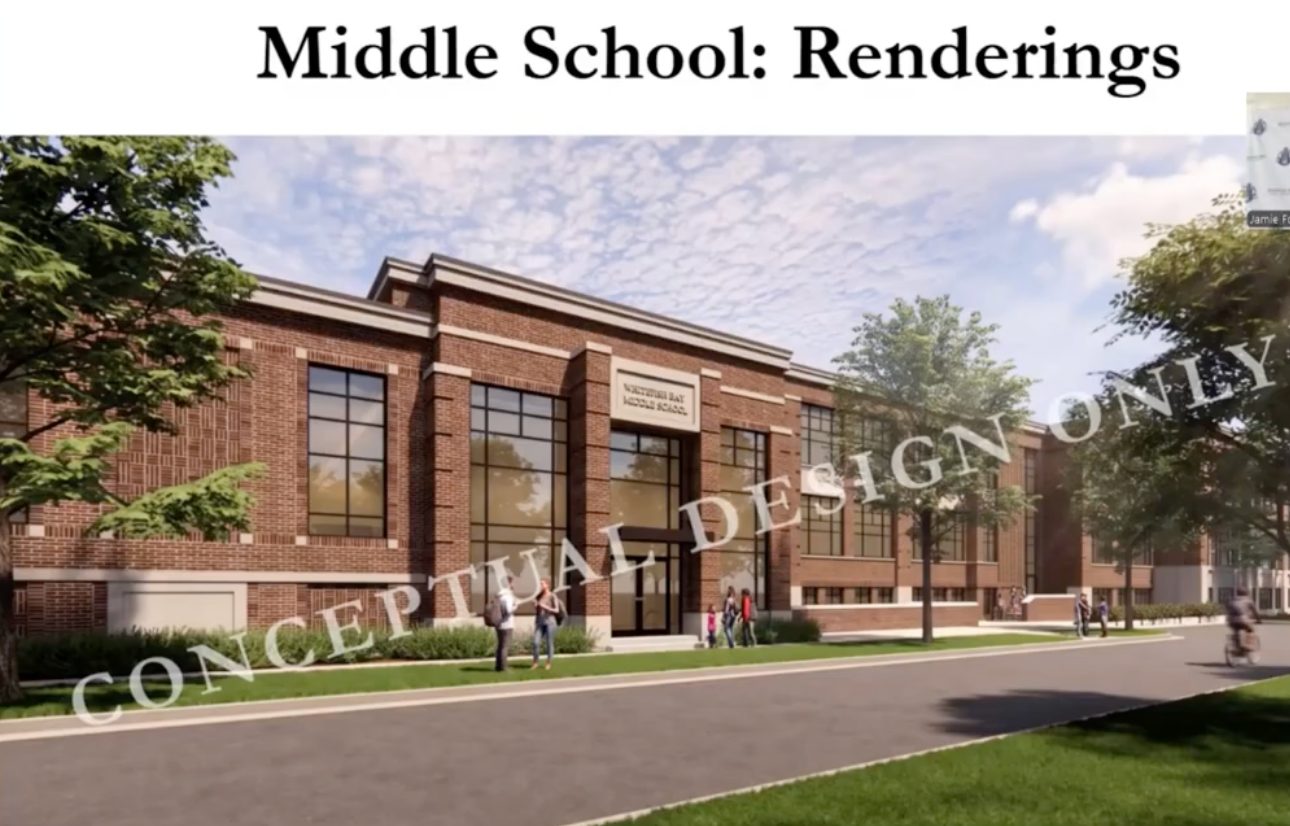
Conceptual Exterior Rendering
The district's rendering illustrates one possible exterior treatment while retaining and renovating portions of the existing historic building.
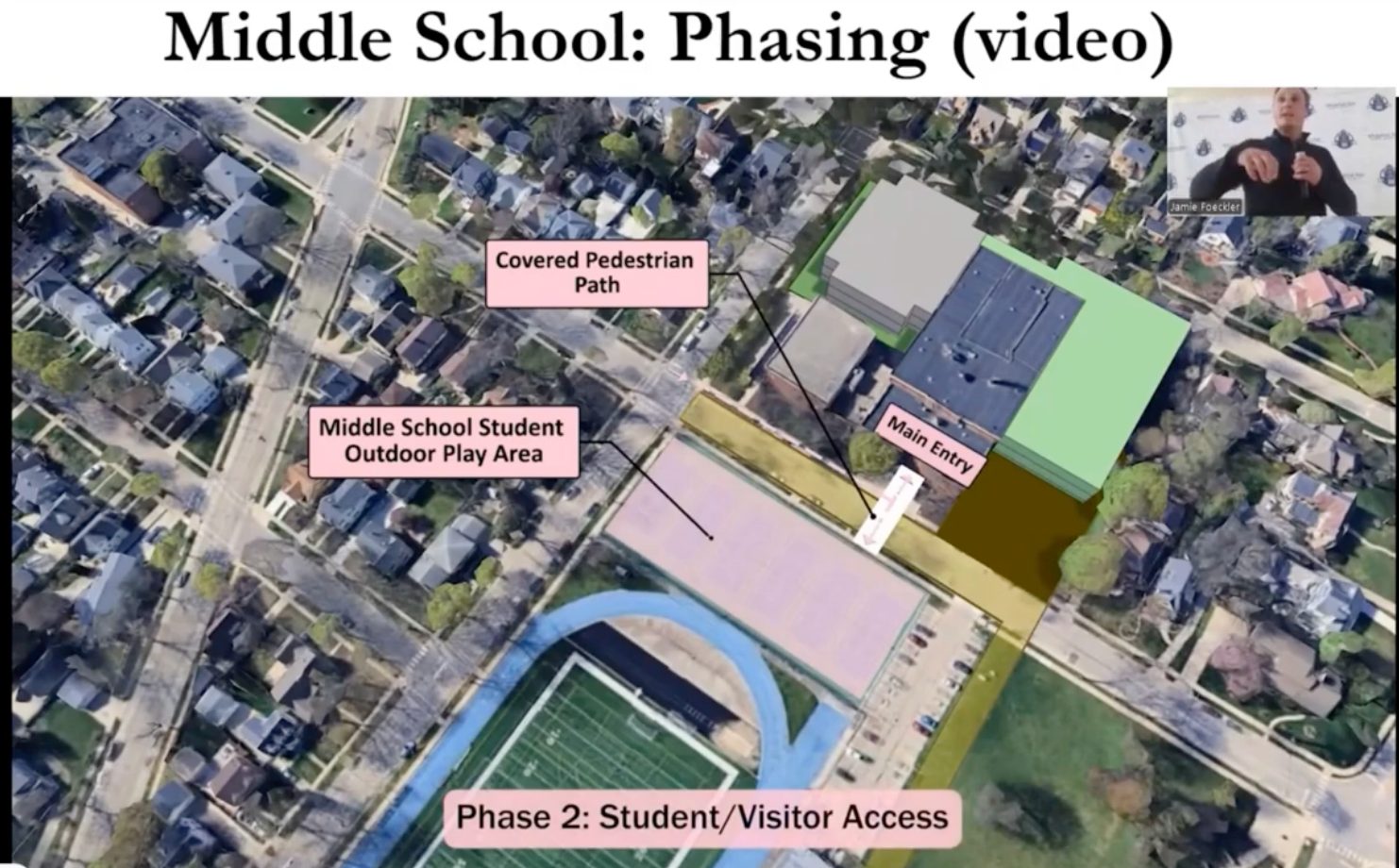
Construction Phasing
The current sequence is designed to keep the school operating while new space is built, students move, and later sections are demolished or renovated.
Select a tab to switch views. Click an image to enlarge it.
Memorial Day 2026
A Community Tradition at Armory Park
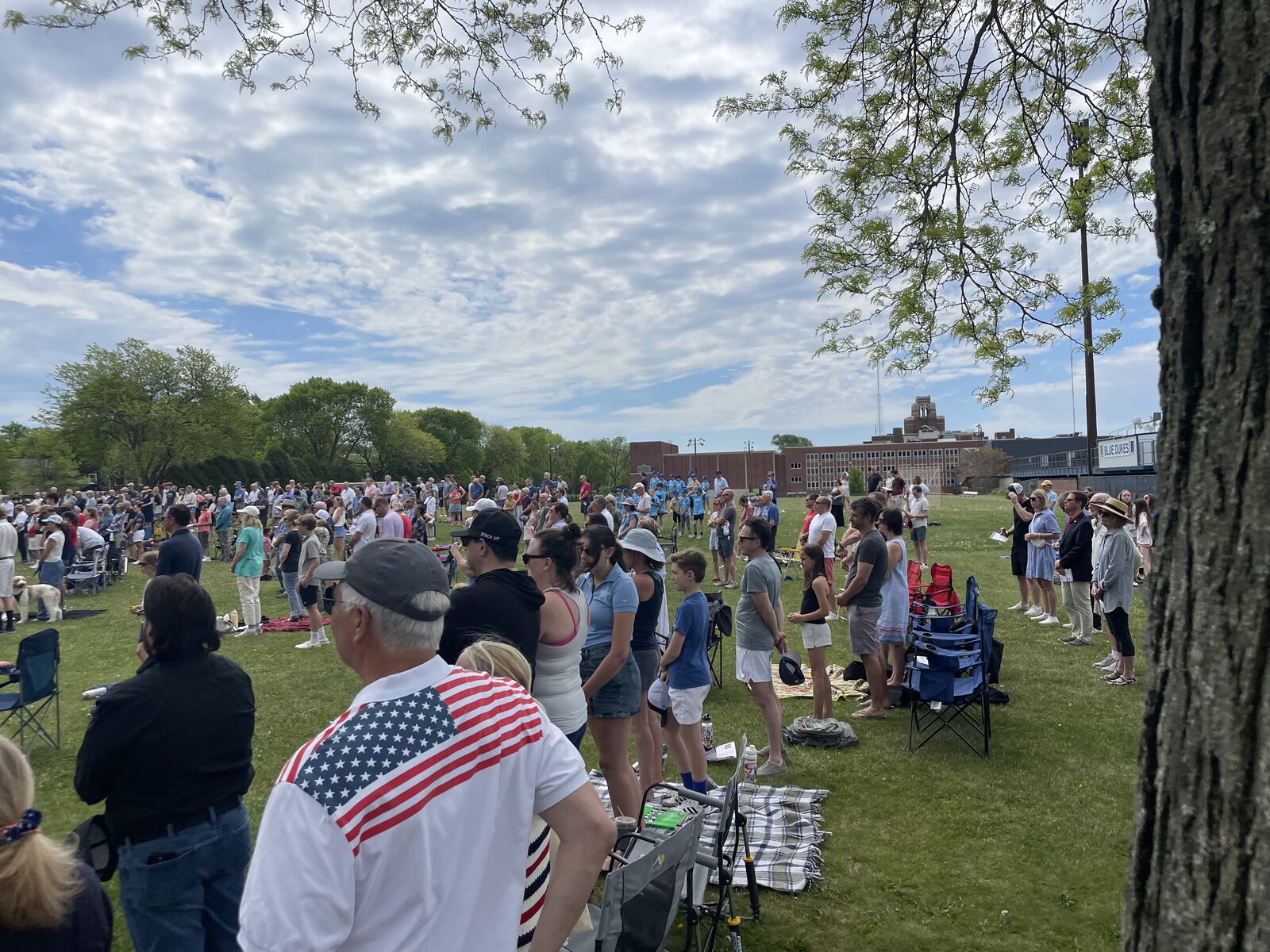
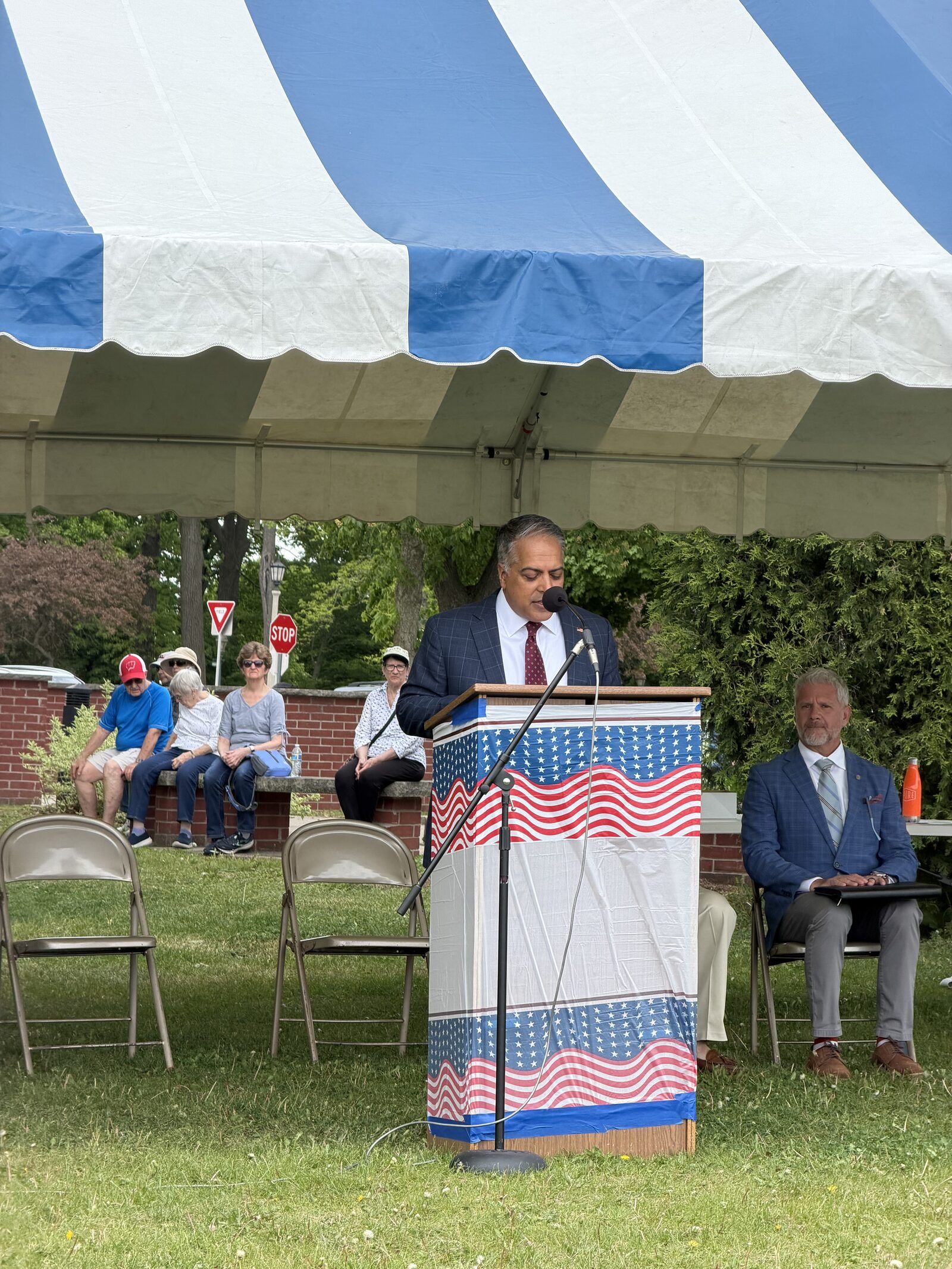
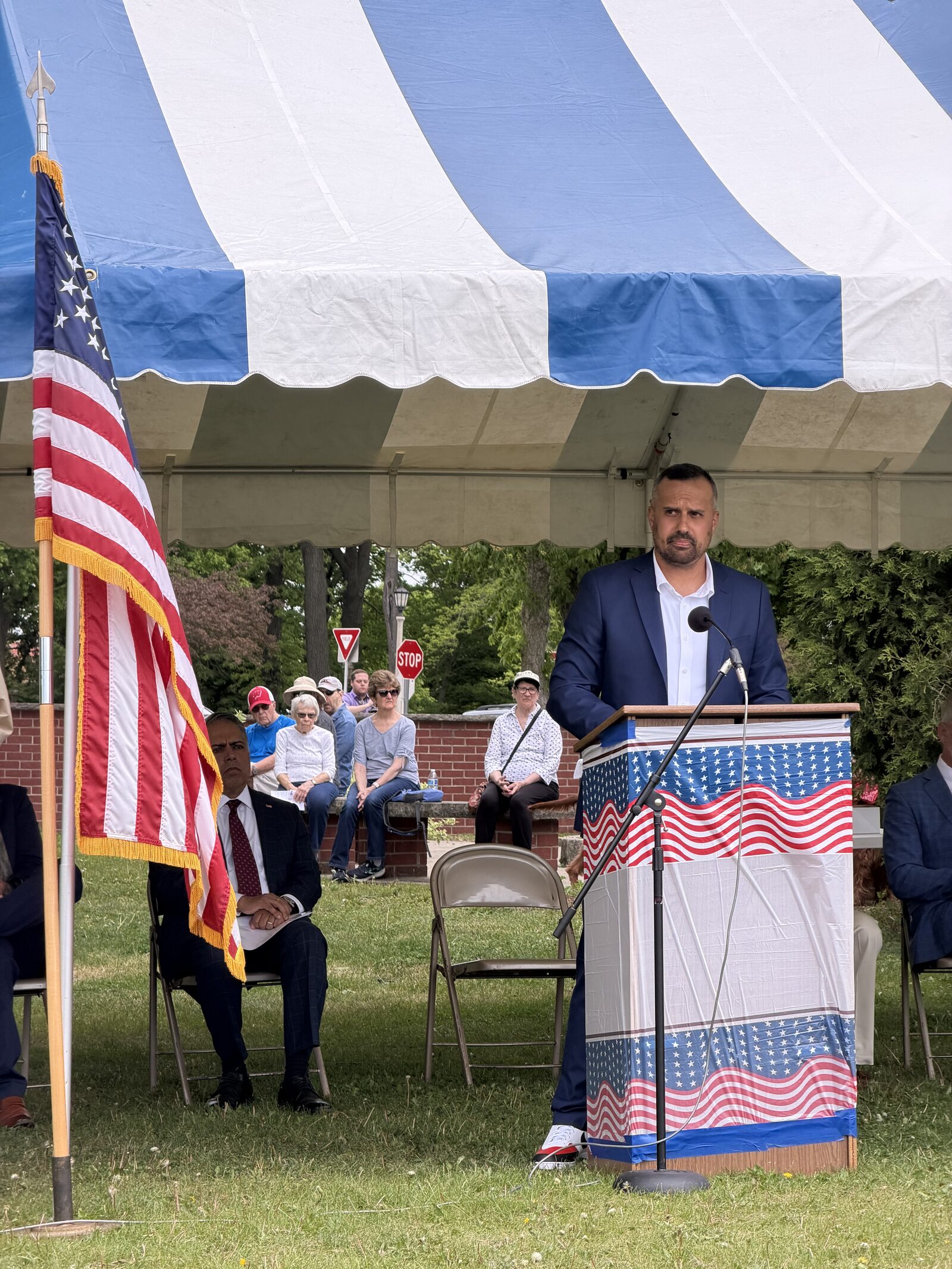
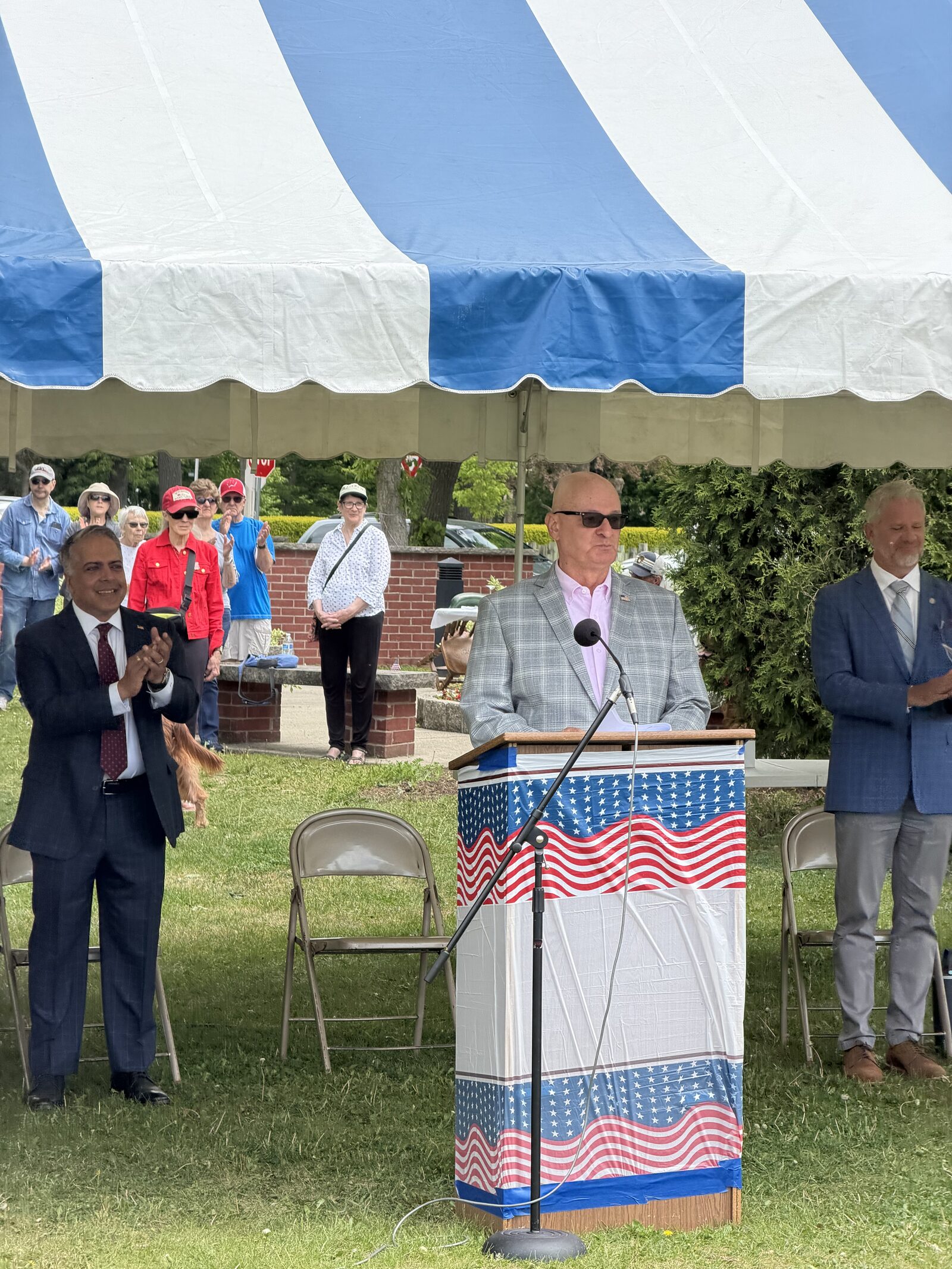
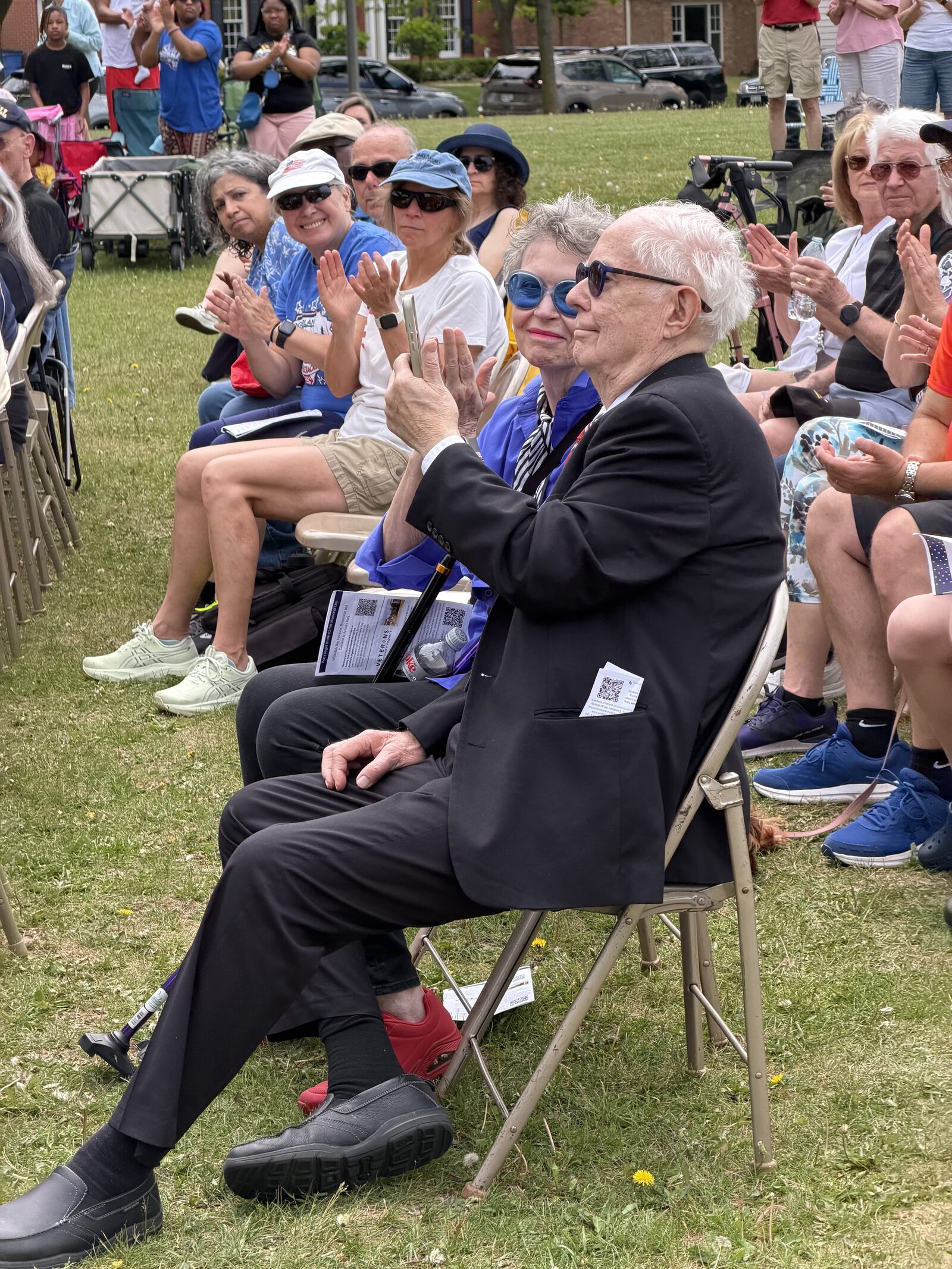
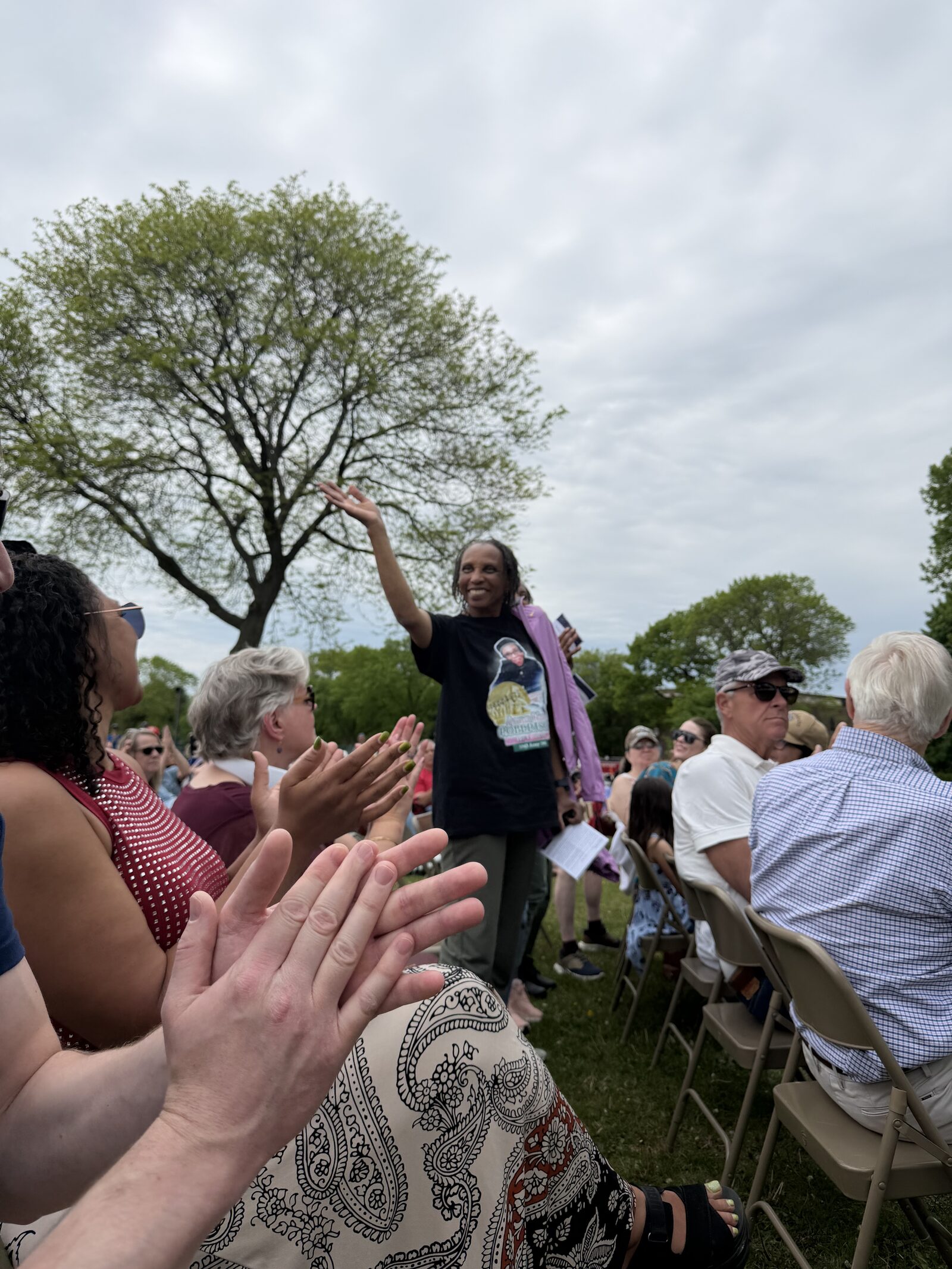
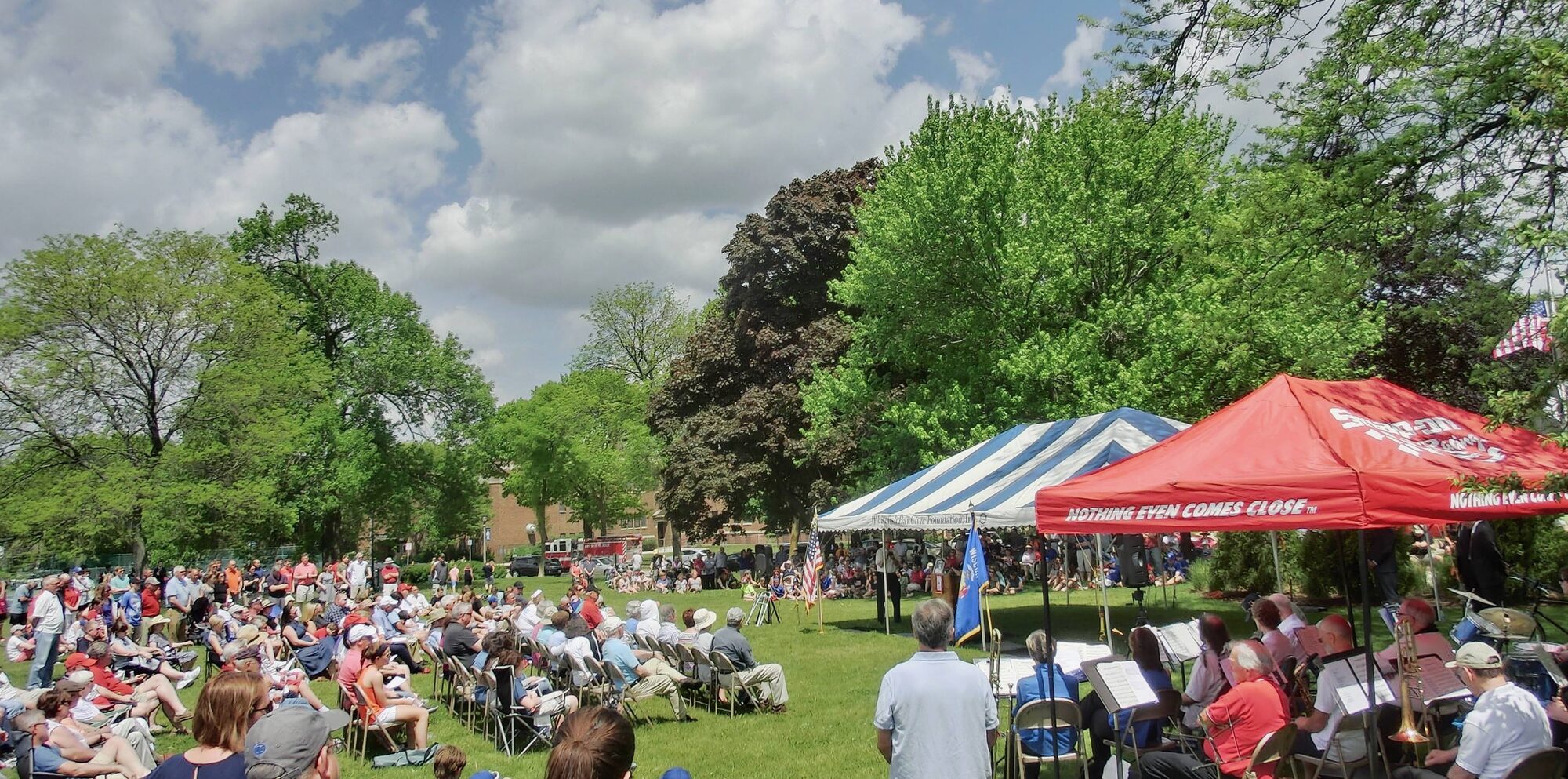
Hundreds of neighbors gathered at the Veterans Memorial for Whitefish Bay’s annual Memorial Day service. This gallery preserves a snapshot of the community gathering and the memorial setting at the heart of Armory Park.
Armory Park is not part of the district's current middle school construction site. That creates an opportunity to keep the focus on what comes next for the park itself. The Friends of Armory Park — working with the Village of Whitefish Bay — are raising funds for Veterans Memorial beautification and park improvements.
What Your Contribution Supports
🎖️
Veterans Memorial BeautificationImprovements to the memorial area honoring those who served — keeping it a fitting place for remembrance, reflection and community gatherings.
🌳
Trees, Plantings & Green SpaceCare for mature trees and landscaping that make Armory Park a welcoming public space year-round.
🪑
Park Amenities & CareBenches, pathways, signage and other improvements that support the park's long-term use.
Contributions are processed through the Village of Whitefish Bay for Armory Park improvements.
Friends of Armory Park
Contribute Through the Village
Donations are processed securely by the Village of Whitefish Bay.
You'll be redirected to the Village of Whitefish Bay's secure online payment portal.
See For Yourself
Visit Armory Park
Take a virtual walk through Armory Park and see the Veterans Memorial, mature trees and open green space that remain outside the current middle school construction concept.
Stay Connected
Stay on the Mailing List
Add your name for updates on the November 3 facilities referendum, district information sessions, middle school planning and long-term stewardship of Armory Park.
Your email will never be sold or shared with third parties. Comments may be shared with Village and School Board leaders.
📬 Prefer to stay anonymous?
You can join our mailing list without adding your name to the public list. We'll keep you updated on board meetings, district news, and ways to engage.
✓ You're on the list. Thank you!
🌳
You're on the List — Thank You!
We'll send updates on the November referendum, middle school planning and Armory Park. In the meantime, share this page with neighbors who want to stay informed.
Older spring and early-summer posts are preserved here for anyone who wants the full record of the debate and how the current November proposal developed.
Earlier Updates & Background
Earlier updates from the spring and summer are preserved here for residents who want the full history of how the November proposal developed. The current referendum, FAQs, voting information and middle school concepts now appear first on this site.
Want updates as they happen? Add your email to our mailing list in the Stay Connected section below. We'll share updates on the November referendum, community information sessions and major developments affecting Armory Park.
Browse the spring and early-summer archive
July 2026Focus Group Summary
District Shares Summary from Friends of Armory Focus Group
Superintendent Dr. Jamie Foeckler sent the following letter to the 21 participants of the July 20 focus group session, summarizing three primary themes that emerged. The strongest: participants want the Veterans Memorial preserved at its current location in Armory Park.
📋 Biggest takeaway
Of the three themes the district identified, the strongest and most consistent was preservation: participants want the Veterans Memorial and Armory Park left where they are. The full letter, including all three themes, follows below.
Dear Focus Group Participants,
Thank you again for dedicating your time and energy to our focus group session on July 20th. We are incredibly grateful to the 21 community and extended community members who came together to share their honest feedback, perspectives, and ideas.
Our team has finished thoroughly reviewing the data, notes, and individual responses from our session. Your input was clear, and three primary themes emerged as the most critical priorities for our community at the July 20th focus group:
1. Sacred Ground, History, and Preservation of Armory Park
What we heard: Participants emphasized that the Veterans Memorial and Armory Park sit on hallowed, irreplaceable ground where local soldiers historically trained. The physical location — including its mature trees and original footings — holds value, and community members feel strongly that moving, altering, or building over this space would destroy a vital piece of local history.
The consideration: Respecting the emotional and historical attachment to the existing site is paramount. Securing long-term protections for the green space, such as deed restrictions or park covenants, will be key to addressing community fears of losing this beloved space.
2. Middle School Integration and Safety Concerns
What we heard: Attendees rejected the idea of integrating the memorial into a new middle school campus or co-locating it directly adjacent to student activity. Participants noted that a memorial requires solemnity, quiet reflection, and open public access, which directly conflicts with school operations, student safety concerns, potential noise, and risks of disrespect or vandalism.
The consideration: Co-locating the memorial on a school campus is widely viewed as a non-starter. Demonstrating a preference for a "renovate in place" middle school model — or clearly illustrating how the school footprint will fully respect and remain entirely separate from the memorial space — will be important to earning community backing.
3. Civic Education, Inclusivity, and Process Transparency
What we heard: Participants value the memorial as a living, intergenerational teaching tool for local youth and feel the space is already welcoming and accessible. Rather than physical changes, participants want better integration into local history curricula, clear communication, and transparent plans. Furthermore, attendees noted that cost should not be a barrier for family plaques, as local crowdfunding and civic groups stand ready to assist.
The consideration: Future proposals need to focus on civic engagement and educational partnerships rather than physical site redesigns. Providing early architectural renderings, detailed budgets, and transparent options, alongside maintaining community-backed funding pathways for plaques, will build long-term trust.
Expanding the Conversation
The focus group you attended serves as a vital piece of this puzzle, but was just one part of our broader community listening effort. We also hosted additional discussions with neighbors of the middle school as well as local historical and community stakeholders to ensure we gathered a wide range of viewpoints. We remain in communication with the Village on any possible future plans. In partnership with these targeted conversations, we launched a community-wide survey in July to give all residents an opportunity to weigh in on these critical discussions.
What Happens Next?
Please know that this feedback and data are being delivered directly to District leadership and the School Board to guide next steps over the next few months. We are committed to using your insights to ensure our path forward remains rooted in collaboration, transparency, and fiscal responsibility.
Thank you for taking such an active part in shaping the future of our community.
Warm regards,
Dr. Jamie Foeckler
July 2026Statement
A Statement from the Friends of Armory Park
"We, the Friends of Armory Park, do not support a referendum that impacts the Veterans Monument and Memorial Garden at Armory Park." The Friends of Armory Park, joined by dozens of Whitefish Bay residents, respond after the school district reached out for their input.
The Whitefish Bay School District has contacted the Friends of Armory Park to gather our thoughts on the Veterans Monument and Memorial Garden. We would like to answer clearly.
"We, the Friends of Armory Park, do not support a referendum that impacts the Veterans Monument and Memorial Garden at Armory Park."
The Armory Park memorial location and design are not accidental. They were chosen deliberately to honor the history and character of the site.
This land began housing National Guard units in 1908, and the Armory was used by the National Guard units until 1995. On these very grounds lived and trained national guardsmen who served and died in WWI, WWII, Korea and Vietnam. The memorial architecture honors the Red Arrow Division and features a garden for reflection beneath trees that have stood for roughly a century.
We have reflected and discussed the future. When the district asks where we want the memorial to reside, our answer is simple: The Memorial should remain at Armory Park, where it is now.
We ask the district to consider and seek second architectural firm opinions for the Middle School, including renovating the existing school and construction at alternative sites.
We offer this statement in partnership. We believe the Whitefish Bay School District is capable of excellent schools, while preserving this beautiful park and this lasting memorial so that it may be enjoyed by all Whitefish Bay residents for generations to come. The district asked for our input, and this is it: Improve our schools while saving the current Veterans Monument and Memorial Garden at Armory Park.
Signed,
Bill Miesel Caretaker, Veterans Monument and Memorial Garden at Armory Park
Hospital Corpsman (FMF), U.S. Navy 1979–1983
Captain, U.S. Army (Retired) 1983–1993
Ellen Abrams Blankenship Co-founder, Veterans Monument and Memorial Garden at Armory Park
Sister of Lt. John Abrams, Whitefish Bay High School class of 1958, KIA in Vietnam in 1968
David Kurtz Co-founder, Veterans Monument and Memorial Garden at Armory Park
Past State Commander and Adjutant of The American Legion
Former Chief Warrant Officer, US Army
Dan Carey Former Captain, U.S. Army
Memorial Day Ceremony Founder and Organizer
Joe Rice Former Village Trustee and Milwaukee County Supervisor
Anoop Prakash Whitefish Bay Memorial Day Committee
Former Captain, US Marine Corps
James Gomez Whitefish Bay Resident
Former Major, US Marine Corps
Community Co-Signers
Ann Harmsen
Beth Lueck
Betsie Berrien
Bob McBride
Brant McCartan
Chris and Tricia Harris
Christopher Byrnes
Cris Slawinski
Dan Cotrone
Diane Kealty
Elisabeth M. Baertlein DMD
Elizabeth Deakin
Gita Sinha
Jennifer Haas
Jess Cigelske
Jim David
Joe and Stacy Wollersheim
Joyce Davis
JT Mulcahy, US Army retired SFC
Kara McCaffrey
Kathy Pejsa
Kay Gargano
Laurence Moon
Mary McPhail
Meg Castro
Mike Bortolotti
Patricia Mueller
Rob Mulcahy
Rondi Bystrom
Sarah Chapman Wilson
Scott Deakin
Steve Slawinski
Steve Wnuk
Tim Cigelske
Tom Gleason
Vanessa Kleiner
June 17, 2026Board Meeting Recap
Whitefish Bay School Board Rewrites Its $30,000 Consultant's Survey
At its June 17 meeting, the board spent about 90 minutes line-editing the community facilities survey the district is paying the Donovan Group $30,000 to produce. No one from the Donovan Group was in the room.
At its June 17 meeting, the Whitefish Bay School Board took up the community facilities survey that will shape whether a referendum lands on the November 2026 ballot. The survey is the centerpiece of what the district calls its "listen" phase.
The board spent roughly 90 minutes, from the start of the agenda item just before 8 p.m. to the approval vote at 9:19, working through the survey line by line and rewriting large portions. This is the same survey the board is paying the Donovan Group $30,000 to produce. No one from the Donovan Group was in the room.
Here's how the board got here.
They debated a survey for weeks and decided against one. Then added one at the last minute.
A community survey is not a new idea for this board. It has been on the table since shortly after the April 7 defeat, and the board kept circling it without committing. Through late April and into May, members debated a survey and a community facilitator as the two main tools for understanding why the referendum failed.
In early May, after weeks of internal back-and-forth, the board moved away from the survey — some members wanted structured feedback, others raised concerns about timing and cost, and it did not move forward.
The listening question came up again in mid-May, when the board issued a request for proposals for two separate roles: a community engagement facilitator and a communications firm. Members described the facilitator as the priority, with one calling it "essential," while voicing unease about hiring someone to help "sell" a referendum.
The board debated a survey and declined it. It set up a process to hire a listening facilitator and then hired none. And now, having backed away from the survey twice, it has commissioned one in the middle of summer — the exact timing its own consultant warned against.
The consultant told them summer was the wrong time
The warning is on the record, from the firm the district is paying. At the May 27 meeting, board president Kristin Bencik-Boudreau asked Donovan Group partner Brian Nicol about surveys.
He advised a simple survey from his experience: how did you vote, and why? But he cautioned that surveying in Wisconsin over the summer would hurt the response rate, and he said the prospect gave him pause from his own experience running referendum campaigns.
"I would not be giving good advice if I didn't say surveying in Wisconsin in the summer will absolutely impact your response rates. I get a little heartburn over that from my own personal experience."
— Brian Nicol, the Donovan Group, May 27
The window Nicol flagged as the weakest for getting a representative response is exactly the window the district chose. A survey whose results may not be representative because of when it runs is then set to become the evidence base for a $90 million-plus November referendum decision.
The Donovan Group is the Wisconsin public-relations firm the district hired in late May to run referendum communications. The contract is for $30,000.
According to the timeline the firm provided, the district works with Donovan every week on survey revisions, postcards, and deadlines, with the survey open through July, data analysis in early August, and results presented to the board on August 12.
The professional survey writing is the product. What the board did at this meeting was take the draft that product produced and substantially rebuild it.
A live rewrite of a professional draft
In introducing the survey, Bencik-Boudreau said she "didn't like how it was laid out" and invited comments from board members.
The demographic section came apart immediately. The group reworked how the children-in-school question was structured, argued over whether grandchildren should count, whether to break out residents who attended Whitefish Bay schools themselves, and whether the answers should be "select all that apply" or yes-or-no.
From there the board moved through the questions one at a time, rewording the language on the failed April referendum, debating whether to describe it as "not approved" versus "rejected." (They went with "not approved.")
They rewrote the middle school location description paragraph through multiple read-alouds, and re-litigated how to phrase the question about why residents voted no. Much of the meeting was spent on word choice, sentence structure, and tense.
Brett Christiansen, who pushed many of the edits, argued that the firm "didn't give a survey" the board could simply accept, and that without anyone from Donovan present to explain the reasoning, he was not willing to defer to the draft as written.
Dan Tyk made the same observation from the opposite angle. In the middle of a long stretch of the board rewording questions one phrase at a time, he said: "I'm okay at going through this, but I think the more we think about this, we hired a firm. When we start wordsmithing, we're taking… we should have just written the survey then. They do this professionally. There's reasons behind why they wrote it."
"When we start wordsmithing… we should have just written the survey then. They do this professionally. There's reasons behind why they wrote it."
— Dan Tyk, Whitefish Bay School Board
When listening drifts into "push polling"
A survey in a genuine listening phase is built to measure what people already think. A push poll, by contrast, is a technique that attempts to shape opinion under the guise of asking for it, by putting a persuasive premise in front of the respondent and inviting agreement. The term is used broadly for legitimate surveys that lean on leading questions. The common thread is wording that "pushes" the respondent toward a predetermined response.
To be clear, this survey is not a push poll in the strict sense. The board plainly wants real data, and several members fought hard to keep the questions neutral. Yet at several points the drafting drifted toward the leading end of that spectrum, with questions that carried a premise rather than testing one. To the board's credit, members caught some of them.
The clearest example was a proposed item on deferred maintenance. The draft language argued that including the projects in a November 2026 question would "allow the district to save money on maintenance and construction costs," with the alternative framed as paying more later.
Dan Tyk put the problem plainly, saying the language amounted to telling residents that delaying "may cost more to try to drive a certain response," and that this "should be information," not a survey question. Another member said simply that the section did not fit and did not belong. The board voted to strike it.
Nate Christenson made a related point about the survey behaving like a sales pitch: a question that effectively tells a resident "spend $6,000 more and you get this" is an upsell, not a measure of what people can afford. And when the district is asking residents how much they can invest, "we just need to ask the question."
The same pattern showed up in the survey's framing language. The introduction told residents their feedback "will directly decide" the November ballot question. Christiansen objected that the phrase was too strong and pushed to soften it to "help inform," noting the ballot question itself is only potential at this stage. The board agreed and changed it.
The question about the middle school carried a version of the same problem. Before residents were asked their view, the survey described the April plan in the district's own favorable terms — a new school built "over a portion of Armory Park" that would "recreate and honor the Veterans Memorial." That is the language the district used to sell the plan, and it leaves out cutting down mature, decades-old trees and uprooting the existing Veterans Memorial, with no plan for what replaces it.
Not every edit pushed the survey toward persuasion, and voices in the room often pushed the other way. Tyk in particular kept returning the conversation to its stated purpose, saying that in the listening phase "we should not be telling anybody anything."
Where were the $30,000 consultants?
The absence of the firm hung over the exercise, and more than one member named the contradiction. The district paid $30,000 for professional survey design, then spent an evening overriding that design without the designers present.
"This is a considerable amount of money that we're spending in a short period of time, and I just, I get worried that they're not as engaged," Tyk said.
Christiansen, even while voting yes, said he wished Donovan had been present to walk the board through what happens if the response sample turns out not to be representative, so members could prepare rather than scramble to interpret the results "in real time." When a staff member offered reassurance that the firm's analyst is invested and does this work nationwide, Tyk did not let it go. "They're not here. I get concerned," he said.
"They're not here. I get concerned."
— Dan Tyk, Whitefish Bay School Board
A staff member responded that the Donovan Group "would have liked to be here tonight" but had other obligations. The survey passed anyway.
What happens next
The district has built its November timeline around a "listen, learn, launch" framework that treats the survey as the objective signal that tells the board what the community will support.
The board also declined to run a survey twice before reversing course. It put the survey in the field during the summer months its own paid consultant explicitly warned would depress response rates. It then assembled the questions itself, with framing members repeatedly flagged as leading, while the professionals hired to write it were not in the room.
Results will be gathered through July, analyzed in early August, and presented on August 12. The board will then have roughly two weeks to turn those results into a potential ballot question for November.
Then the 70-to-75-day sprint will begin.
June 10, 2026Board Meeting Recap
The Board Says It Wants to Listen. The Plan Still Looks Like April.
The Whitefish Bay School Board continued their discussion of listening to the community following the failed April 7 referendum, while the sole plan being discussed has continued to focus on a new building on Armory Park that voters rejected in April.
📺 Previously, in Whitefish Bay School Board meetings
Meanwhile, board member Nate Christenson has consistently called out other board members for appearing to move quickly without heeding the result of the defeated referendum: "I thought that we had decided as a board to go through a period of listening," he said. "This is not listening. This is telling, right?"
The board must decide on a November 3, 2026 referendum question by mid-August. In that compressed timeline, the district has only so far discussed how to repackage the April 7 plan that was already voted down.
The board said as much, in its own words.
During a debate over how to word the focus group questions, board president Kristin Bencik-Boudreau pushed back on language that might suggest the district was rethinking its approach: "We're not proposing anything new."
"We're not proposing anything new."
— Kristin Bencik-Boudreau, Whitefish Bay School Board President
The projects themselves, by the board president's own account, are the same ones voters rejected 52–48 on April 7. The only site concept shown at the meeting was the Armory Park site. District architect Nick Kent presented memorial concepts designed around the new middle school footprint from the failed referendum.
The village is asking questions
The most consequential development of the night involved land the district doesn't own. The Village of Whitefish Bay has asked the school district for a memorandum of understanding, requested visual examples of what a relocated veterans memorial could look like, and wants the district to choose between two options: building the memorial into the new school's exterior, or placing it on reallocated green space.
Before April, the district presented the Armory Park site as the plan without any executed agreement with the village. Now the village wants commitments in writing before anything moves.
Superintendent Dr. Jamie Foeckler framed the MOU as hypothetical work if this plan were to advance: "You have to do the homework in order to have that in place, otherwise you get to the point where you're making decisions" without it. Asked when the village needs an answer, Foeckler said: "Preferably… by the end of August, we would have a question already determined."
In this timeline, the agreement enabling a school on Armory Park is being drafted in parallel with the listening sessions.
The tension between planning and listening
The central tension in the discussion was between the push to move forward with ideas for a plan that resembled April 7, without yet discussing with the community and stakeholders for the memorial.
The strongest caution came from board member Pam Woodard, who reminded her colleagues who owns the park land. The district, she said, "may or may not go back to ask for land that we do not own — the village does — in order to have it even be reconsidered."
On relocating the veterans memorial, Woodard declined to commit without hearing from the people who built it: "I guess I can't fully commit to that… without joining the group that designed it and spent time" on it, along with "key stakeholders." She emphasized that the block's history "has been a key part of how we've been able to educate students in this community for many, many years." She also pushed for the focus groups to come before any return to dollar figures — the point, she said, is "to hear from them prior to taking that next step of continued specifics and dollars."
Board member Sandy Saltzstein framed the sessions the same way, pushing back when the discussion drifted toward re-presenting the projects: the purpose "is to hear from them, not to be talking about projects" — to learn the community's perception of the district's needs and constraints, not to pitch a plan.
Christenson made the sequencing explicit, saying the idea is "we're collecting community feedback before" the board lands on a question.
Archived video omitted from this lightweight private review build.
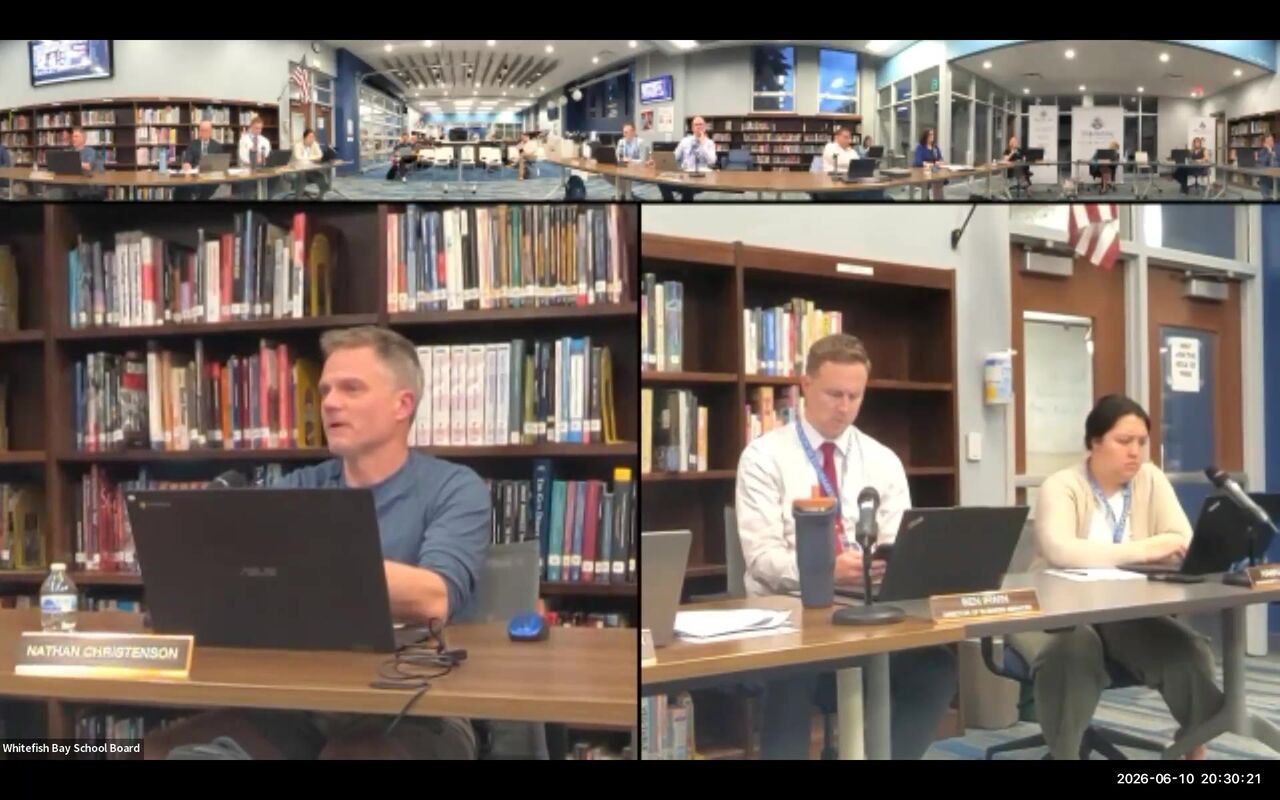
From the June 10 meeting: Board member Nate Christenson addresses the board. Video from the Whitefish Bay School District's official meeting recording.
And board member Brett Christiansen acknowledged what vagueness cost last time. Talking to residents before April, he recalled hearing that assurances about the memorial — "well, it will be something" — "didn't necessarily help" win over "people who had an attachment to that" space.
Board member Dan Tyk pushed in the same direction on how the focus groups themselves should be run. "I personally, I think I'm hoping it's open-ended, like what it's sort of a way of saying, like, what brought you here tonight," he said — favoring a session that lets participants set the terms rather than respond to district prompts.
That's most of the seven-member board, on the record, insisting the community gets heard before the district recommits.
The alternatives that weren't in the room
Despite only one plan being discussed, other options for middle school upgrades do exist. They were raised throughout the spring campaign, and some were studied in the district's own multi-year planning process. None of them came up at this meeting:
Renovating the existing middle school. The district's own Facilities Condition Assessment documents the building's needs — accessibility, HVAC, infrastructure. Addressing them in place, on land the district already owns, is the default alternative to demolition. It received no discussion.
Splitting the question. Roughly $88 million of the April package — ADA upgrades, safety and security improvements, HVAC and infrastructure work at Cumberland, Richards, the high school, and Lydell — had broad community support. A two-question referendum would let voters fund that work without it being tied to the contested new building in November. It received no discussion.
The board's own deliberations before April included scenarios at a range of scopes, locations and price points, meaning multiple versions of this plan have existed on paper. Yet the only concept presented at this meeting, the only land deal being negotiated, and the only project list headed to the focus groups is the one voters rejected on April 7.
Next steps
The first session runs June 16: 16 tables, 16 moderators, at least four registered participants per table, with district administrators or partner groups taking notes. Each question gets two timed minutes per participant before open discussion. Themes will be compiled, emailed to participants, and posted on the district website.
The three questions, after revision: why you voted the way you did in April; what stands out as the district's greatest needs and constraints; and thoughts on tax impact and tax tolerance, kept separate from specific projects.
A key question remains: Is the only plan being considered the one voters already rejected?
May 28, 2026Documents Obtained
$30,000 Contract Maps Out Communications Path to November Referendum
A contract obtained through an open records request shows the Whitefish Bay School District is paying the Donovan Group $30,000 for a referendum communications package. The firm's proposed month-by-month timeline is built around a November 3, 2026 ballot question.
The board approved the hire at its May 27 meeting (see our full recap) without taking up a separate proposal for a community engagement facilitator. The split outcome — communications hired, listening facilitator not — has been the subject of public debate among board members, several of whom have said the district needs to listen to voters before deciding whether and when to return to the ballot.
At the May 27 meeting, board member Nate Christenson described the dynamic directly: "This is not listening, this is telling," he said, adding that "building up tools to tell" was different from the listening period the board had committed to.
The Donovan Group's proposal, dated May 20 and signed by a partner at the firm, lays out the scope of work and the proposed timeline.
What's in the $30,000 package
The contract covers what the firm labels "Scope B Only: Referendum Consulting, Planning, and Communication." That includes weekly referendum consulting meetings, up to three mailers, one video production, social media planning, copywriting and design, and travel-related expenses. The fee is a fixed $30,000 with no overages, the firm says.
A calendar built around a November referendum
The proposal's most detailed section is its proposed timeline, organized month-by-month leading up to a vote on November 3, 2026. The following is a general communications calendar for a November 2026 referendum.
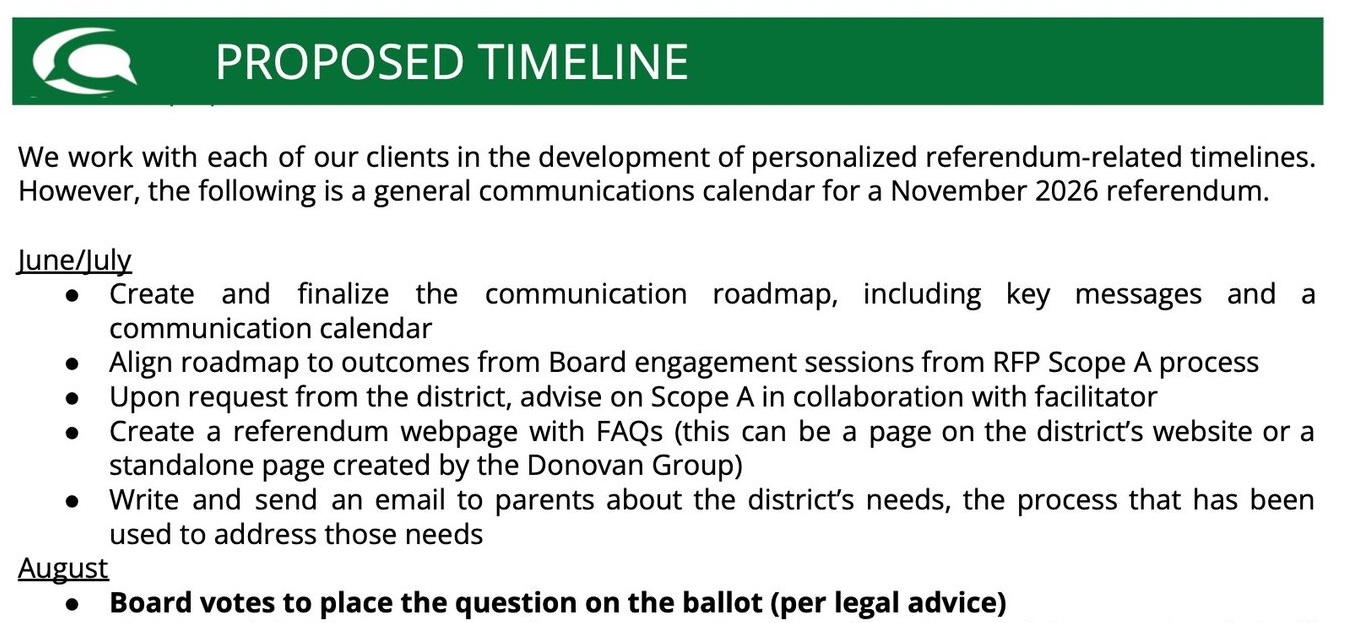
From the proposal: The Donovan Group's "Proposed Timeline" section, showing June/July and August tasks. The August entry begins with the board's vote to place a question on the November ballot.
The template itself is structured around the assumption of a November ballot question. In June and July, the firm would create a "communication roadmap, including key messages," build a referendum webpage with FAQs, and email parents about district needs.
The August entry begins: "Board votes to place the question on the ballot (per legal advice)." From there, the firm would distribute a news release announcing the referendum and the ballot question, create the first of three mailers, begin a social media campaign, and produce a one-page fact sheet on the tax impact of the referendum.
"Board votes to place the question on the ballot (per legal advice)."
— Donovan Group proposal, August 2026 timeline entry
In September, mailer #1 would be distributed to every residential address in the district, mailer #2 would be created, the social media campaign would continue, and a guest article from the board president would be sent to local media. October would include distribution of mailer #2 and email reminders to all parents.
The timeline does not lay out an alternative track for a scenario in which the board, after gathering more community input, decides not to return to the ballot in November, or how to incorporate any feedback from listening sessions into the ballot question. The general calendar moves from a June/July roadmap to an August ballot vote without intermediate decision points.
Two scopes, one hire
The district's request for proposals had asked firms to bid on two separate categories of work: Scope A (community engagement facilitation) and Scope B (marketing and communications). The Donovan Group submitted a proposal "in response to Scope B only," according to the firm's letter of interest to Superintendent Dr. Jamie Foeckler.
The district's own RFP acknowledged that engaging the community and communicating a referendum were separate skill sets, calling for separate firms. After the May 22 interview process, the review committee recommended Donovan for Scope B. No finalist was brought forward for Scope A.
The board has committed paid resources to communications but has not, so far, hired anyone to facilitate the listening process several members described as a priority. Two community focus groups are scheduled for June 16 and July 14.
The May 27 outcome marked a reversal from the board's May 13 discussion, when board member Lynn Raines had called the facilitator role "essential" and members had advanced the RFP with the facilitator described as the priority. At that earlier meeting, multiple members had expressed unease about communications help and the perception of paying someone to "sell" a referendum.
This follows a similar pattern from earlier in May, when the board moved away from a community survey after weeks of internal debate. Some members had been in favor of a survey to gather structured feedback on why the April referendum failed; others raised concerns about timing and cost. The survey did not move forward.
What's next
At the May 27 board meeting, the firm's representative described its role as helping districts during what he called "that 70- to 75-day sprint from that board vote to election day." The proposed timeline lines up almost exactly with that sprint.
The board's next facilities planning discussion is scheduled for June 10. Members have not formally decided whether to commit to a November 2026 referendum, what dollar amount to bring forward, or whether additional steps to gather community feedback will precede that decision.
The contract the district has signed is built around a template for that November timeline — leaving open the question of whether the listening process several board members have called for will fit within it.
📅 Regular Business Meeting · Wednesday, June 10, 2026
7:00 p.m. · High School Library Media Center · 1200 E. Fairmount Ave., Whitefish Bay
Public participation will occur in person in the High School Library Media Center. Persons interested in viewing remotely can register for the Zoom meeting. Public comment can be made in person or by emailing the Board President and Vice President.
The full Donovan Group proposal was obtained through an open records request to the Whitefish Bay School District. The archived PDF is omitted from this lightweight private review build.
May 27, 2026Board Meeting Recap
School Board Hires Communications Firm but No Facilitator, as Members Debate Listening vs. Telling
The Whitefish Bay School Board approved hiring a communications firm experienced in referendum campaign communication at its May 27 meeting — but did not select a community engagement facilitator, despite having described that role as a priority just two weeks earlier.
The board voted to bring on the Donovan Group, a Milwaukee-based firm whose lead partner has run dozens of school referendum campaigns, for referendum-related communication services. The firm works exclusively with public schools and districts on communications planning, surveys, crisis communications, and referendum campaign consulting.
📄 Related: Our analysis of the $30,000 Donovan Group contract, obtained through an open records request, examines the firm's month-by-month timeline and what it reveals about the path forward.
The search for a facilitator to lead community engagement sessions produced no finalist. The split outcome came during a three-hour meeting marked by a recurring disagreement among board members over whether the district is genuinely listening to voters in the wake of the failed April referendum, or preparing to tell them what it has already decided.
"This is not listening, this is telling"
The tension surfaced early, during a discussion of a proposed memorandum of understanding with the Village of Whitefish Bay regarding potential future use of Armory Park — the same village-owned land at the center of the defeated referendum.
Superintendent Dr. Jamie Foeckler explained the MOU would only take effect if the community eventually approved a project, and was intended to put prior verbal understandings in writing. To some board members, formalizing an agreement over Armory Park signaled the district was again heading down the path of the plan voters had just rejected.
Nate Christenson questioned the timing. "Proceeding with the memorandum of understanding now, like before we've gone through the process of garnering community feedback, I am not sure," he said. "I think doing it now is premature."
Board President Kristin Bencik-Boudreau disagreed, framing the document as informative rather than premature. "I think it's good to have that going into these discussions, because I think people can look at it and say, well, this is what if we go through with it, this is what would happen with the village," she said.
Dan Tyk took a middle position, saying the MOU answered a legitimate question — whether the land was even available — while urging restraint. "I also think we have to proceed with caution, right? Like, we haven't heard from the community again," Tyk said.
"I also think we have to proceed with caution, right? Like, we haven't heard from the community again."
— Dan Tyk, Whitefish Bay School Board
But Tyk also pushed the board to keep its eye on the decision it ultimately has to make. The board's job, he said, was to settle on a referendum figure it believes represents the best option and can defend to the voters who elected it.
"We know 135 million was too much. We know that," Tyk said, arguing the number "is what drives this entire process" and that the board needed to decide what amount it was willing to bring to constituents.
Christenson returned to the point more pointedly as the conversation expanded to include possible renderings of the Armory Memorial and project visuals. He said he wanted to build on a concern Lynn Raines had raised.
"I thought that we had decided as a board to go through a period of listening," he said. "This is not listening, this is telling, right? Like building up these images, doing this memorandum of understanding. It's not, it's not listening, it's building up tools to tell, which is fine, right?"
"This is not listening, this is telling, right? Like building up these images, doing this memorandum of understanding. It's not, it's not listening, it's building up tools to tell, which is fine, right?"
— Nate Christenson, Whitefish Bay School Board
Bencik-Boudreau interjected that "It's communicating me as a board feel is the best option."
Christenson pressed the distinction. "Yeah, but that's different," he said. "My only point is that's different than listening, and if that's what the board wants to do, that's fine. I was just trying to point out and make explicit that it is not listening."
He said he was not necessarily opposed to the approach, but wanted the board to be clear-eyed about it. "If people come to us and say … you didn't listen, you're just trying to tell us what you had already decided — that's okay, if that's what we decide to do," Christenson said. "But I just want to make it very clear that I think that's what this" process was.
A reversal on facilitator and communications
The most consequential action came late in the meeting. Foeckler reported that the district posted requests for proposals on May 14 for two services — community engagement facilitation and communication services — and received two proposals for each. A review committee conducted interviews on May 22.
The committee brought forward a Donovan Group partner as its recommended finalist for the communication services role. For the facilitator role, Foeckler said, the committee "did not have a finalist to bring to the board."
That outcome marked a shift from the board's May 13 meeting, when members had advanced the RFP with the facilitator described as the priority — Raines had called it "essential" — while expressing unease about communications help and the perception of paying someone to "sell" a referendum.
At that meeting, Tyk had asked that the word "marketing" be struck from the proposal, and Woodard had said marketing "will come from other outside groups. That's not our role."
The firm's representative, Brian Nicol, told the board he had been the lead partner on 43 referendum campaigns in Wisconsin over the past four years. He previously spent 17 years in the Howard-Suamico School District near Green Bay, nine of them as communications director.
He described the firm's role as ensuring "every voter is an informed voter."
"We really don't believe referendums fail," he said. "Referendums are just solutions that aren't supported." He added that should the board bring a question forward, the firm would help during what he called "that 70- to 75-day sprint from that board vote to election day."
Asked by Bencik-Boudreau about surveys — an option the board has repeatedly debated and not resolved — he urged caution about the timing.
"I would not be giving good advice if I didn't say surveying in Wisconsin in the summer will absolutely impact your response rates," he said. "I get a little heartburn over that from my own personal experience."
"I would not be giving good advice if I didn't say surveying in Wisconsin in the summer will absolutely impact your response rates. I get a little heartburn over that from my own personal experience."
— Brian Nicol, the Donovan Group
He drew on his Howard-Suamico experience to make the case for surveying anyway. "In 2017 in Howard-Suamico, we failed our first operational referendum question," he said, noting the district put a survey in the field three days later and a second one weeks after that.
The first survey, he said, was essentially two questions: how did you vote, and why don't you think it passed. He said it helped the district move "from thinking we knew what we knew to knowing" — testing whether factors like tax impact, the project's location, or an overall dollar amount above $100 million were really what drove the result.
Throughout his remarks, the firm's framing centered on what it takes to pass a referendum — the "70- to 75-day sprint" to election day, ensuring "every voter is an informed voter," and a track record across dozens of Wisconsin campaigns. That emphasis stood in contrast to the listening-first process several board members had said must come before any decision to return to the ballot.
The board approved the Donovan Group for communication services on a motion from Saltzstein, seconded by Raines, with no opposition or abstentions. No facilitator was approved.
The absence of a facilitator left a larger question unresolved: how the board would gather resident feedback before moving toward another ballot question.
A call for systematic feedback
Lynn Raines voiced frustration with that gap, arguing the board still lacked a consistent method for gathering community input.
"There has to be a systematic way of gathering that information that all seven of us have access to," Raines said. "I think that we have to remain very committed to finding a way forward to get feedback from the community around why people voted no and what would people vote yes for."
Bencik-Boudreau cautioned that focus groups alone would not provide a representative picture. "Any focus group we do is a small percent of the population. You will not reach everyone," she said.
"Focus groups and going out in the community is a good way to spread information, but it's not a way to get a really good feel for what the community is feeling."
Brett Christiansen argued the board's near-term job was to listen, but that doing so required first grounding the conversation in facts. "We need to make sure that our communication, the goal of our communication is not to persuade," he said.
"We're not saying we think this is the best right now, and you should do it. We're saying in April we thought it was the best. This is how we arrived at that. Let us now, as a community, take it from there."
He framed the stakes in terms of residents who felt shut out of the first referendum. "There's somewhere between five and 20% of the voting public who just felt left out, and they want to talk about it, and they don't have an opportunity to talk about it," Christiansen said.
"And they're angry, and they're disillusioned with the process, and they feel like we're sitting in an ivory tower making choices and not including them."
"They're angry, and they're disillusioned with the process, and they feel like we're sitting in an ivory tower making choices and not including them."
— Brett Christiansen, Whitefish Bay School Board
Timeline and next steps
The board confirmed two community focus groups, scheduled for June 16 and July 14 from 6 to 7:30 p.m. at the middle school. A flyer and postcard alerting residents and inviting them to sign up went to the printer and were expected to arrive in mailboxes within days.
Timeline for implementation presented by the district, showing planned steps leading up to the August 25 statutory deadline for a November referendum.
Much of the discussion centered on how to present cost and project information without repeating what several members viewed as mistakes from the first referendum survey.
Christenson argued against attaching specific dollar figures to specific projects, warning it would "compound the question" and make responses harder to interpret. Christiansen countered that residents needed to understand trade-offs — that declining to fund a project now could push costs into the operating budget later, affecting staffing or programming.
A memo from Superintendent Jamie Foeckler laid out three project options for the board to consider, each built around a new middle school and described as a more targeted scope than the defeated proposal.
The options ranged from a $90.2 million net ask to $111.5 million, with safety, fire-protection, and HVAC work added in steps. All three figures are net of more than $17 million the district has already committed from its own capital funds.
The memo asked board members whether that range "accurately captures the spectrum of possibilities" they are willing to consider for a November question.
The board also declined, for now, to send members to set up tables at farmers markets and community events, with Raines, Woodard, and Bencik-Boudreau agreeing the approach would not yield systematic data and might be better suited to a later phase once a referendum question is set. The next planning discussion was scheduled for June 10.
Debt-free milestone
In a separate action, the board approved a resolution to redeem its 2013 general obligation refunding bonds and a 2010 state trust fund loan early, on June 29.
The district's business manager said paying off the debt within the current fiscal year would save just over $20,000 in interest and increase the district's projected state aid by roughly $600,000 next year — reducing the amount it would otherwise need to levy from taxpayers. The district will be debt-free after the payment, and board members paused to applaud the milestone.
What's next
The board is scheduled to resume its facilities planning discussion June 10, with the goal of finalizing materials for the June 16 and July 14 focus groups. Members have not decided whether to commission a formal survey, what dollar range to ultimately put before voters, or whether to return to the ballot in November 2026 or wait until spring 2027.
What the board did decide on May 27: it now has a communications partner with deep referendum-campaign experience, and a still-open question about who, if anyone, will facilitate the listening process several members say must come first.
May 13, 2026Board Meeting Recap
School Board Advances RFP for Facilitator, Communications Support
A community engagement facilitator could cost the Whitefish Bay School District an estimated $20,000 to $30,000, while outside communications support could add another $5,000 to $7,000 per month, district officials told the School Board during its May 13 discussion on next steps after the failed facilities referendum.
The estimates came as board members debated whether to issue a request for proposals for two related but distinct services: a facilitator to lead community engagement sessions and a communications consultant to help the district explain information to residents as it considers whether to return to voters.
The wording of the final motion also reflected the board's discomfort with the term "marketing." The initial motion referred to "community engagement facilitator and marketing communication support."
During a brief exchange before the vote, board members noted that the proposal title included "community engagement facilitation and marketing communication services." Dan Tyk interjected, "But we want to get rid of marketing," and the board appeared to accept that clarification before voting.
The board ultimately approved moving forward with an RFP for community engagement facilitation and communications support, though members repeatedly emphasized that issuing the RFP does not commit the district to hiring anyone.
The discussion followed the defeat of the district's previous $135.6 million referendum, which included a new middle school at Armory Park along with other safety, security and infrastructure projects. At a May 5 meeting, board members had already begun moving away from an immediate post-referendum survey and toward a facilitated engagement process, while also discussing possible PR, marketing or communications help.
The price tag
Board President Kristin Bencik-Boudreau opened the May 13 discussion by noting that the board now had a clearer price range.
Administrators said the facilitator estimate was based on work with other districts and the district's past strategic planning process. The $20,000 to $30,000 range would cover two community engagement sessions, plus possible work between sessions during June and July.
Several board members supported seeking proposals, saying the process would help the district understand what services are available and at what cost.
Tyk cautioned that publicly discussing estimates could affect bids, but said he supported issuing the RFP. "The whole purpose behind being an RFP is really to get somebody to say, like, tell us what you have and how much it's going to cost," Tyk said. "Just because we put the RFPs out does not mean we have to go with either of them."
Nathan Christenson made a similar point, saying the RFP would be "information gathering" rather than a binding commitment. If the responses come back and do not appear worthwhile, he said, the board could decide not to proceed.
"Selling" a referendum
Bencik-Boudreau and others acknowledged the sensitivity around hiring communications help after a failed referendum. She said there is already community concern that such a hire could be viewed as paying someone to "sell" a referendum. "There's some community talk about selling a referendum that can be perceived very negatively," she said. "I think we have to tread lightly."
"There's some community talk about selling a referendum that can be perceived very negatively. I think we have to tread lightly."
— Kristin Bencik-Boudreau, Whitefish Bay School Board President
Sandy Saltzstein said she was sensitive to that concern but favored asking for both skill sets in the RFP so the board could understand its options. "It isn't that we're trying to sell something as much as it is that we're trying to have a very healthy two-way communication from the community and the board," Saltzstein said.
Tyk also pushed back on the idea that communications help would mean selling the referendum. He said the district needed to better explain why it believes a new middle school is necessary rather than renovating the existing building. "For me, the sell is not selling," Tyk said. "It's like, how do we tell our story better?"
He added that some residents still say they do not understand why the district needs a new middle school. "One at a time, we can, you know, pick off those people and try to explain that story," Tyk said, "but we probably … need somebody to help us tell that story better in a way that's digestible to the community."
Lynn Raines strongly supported seeking a facilitator, calling it "essential." "We owe it to our community," Raines said. "I think this is an absolute way of trying to find as much communication from all perspectives within our community."
Pam Woodard said she could support a facilitator and saw value in learning what communications firms might offer, but warned that the district should be clear about the distinction between neutral engagement and referendum advocacy. "I don't see this as marketing," Woodard said. "I consider that trying to tell the information in a way that is understandable for all to make their decision. Marketing will come from other outside groups. That's not our role."
"I don't see this as marketing. I consider that trying to tell the information in a way that is understandable for all to make their decision."
— Pam Woodard, Whitefish Bay School Board
What's next
The May 13 action builds on the May 5 discussion, when board members appeared to move away from a formal survey after questioning whether one could be designed well enough on the district's compressed timeline. At that meeting, Woodard warned against framing the decision as better PR versus public input, saying, "Survey, no survey, we need to engage the community and give them an opportunity to share with us: I voted no because…"
Raines, meanwhile, continued to raise the concern of how the district would hear from residents unlikely to attend a board meeting or public forum. "I just continue to go back to the importance of really trying to reach every household in Whitefish Bay," she said at the May 5 meeting.
By the end of the May 13 discussion, Bencik-Boudreau summarized the board's direction as clear support for a facilitator and majority support for also including communications services in the RFP.
The board then approved the RFP, keeping both pieces in play as the district prepares for community engagement this summer and weighs whether, when and how to return to voters with another facilities referendum.
May 6, 2026Board Meeting Recap
School Board Moves Away from Survey, Explores Marketing
At their May 5 meeting, Whitefish Bay School Board members signaled they are unlikely to move forward with a post-referendum survey, instead leaning toward a facilitated community engagement process and possible PR or marketing help. The discussion marked a subtle shift from the board's April 26 working session, where members had emphasized the need to gather more input before returning to the ballot.
The discussion followed the defeat of the district's previous $135.6 million referendum proposal, which included a new middle school at Armory Park along with other safety, security and infrastructure projects. Board members broadly agreed that the middle school remains a major priority, but they wrestled with whether the next step should be a survey, town halls, focus groups, a communications consultant, or some combination of those tools.
The conversation marked a subtle shift from the board's April 26 working session, where members repeatedly emphasized the need to gather more input before returning to the ballot. At that meeting, board members discussed surveys, focus groups and listening sessions as complementary tools, and several members warned against rushing into another referendum without better understanding why voters rejected the April proposal.
At the April meeting, Pamela Woodard said the board needed to take the result seriously, noting that some residents questioned whether the ask was "too high" or "too much." Sandy Saltzstein raised concerns that previous focus groups had occurred too early to inform decisions about specific projects, locations or siting.
Dan Tyk was especially direct at the April meeting about the risk of ignoring survey results. He noted that the board had gone above the $125 million level where the prior survey had shown majority support, saying, "if we're going to do a survey we cannot sway from what the community tells us in that survey this time, because we will erode trust." He also cautioned that the board had "stretched beyond" what the community had indicated it might support and said, "we have to be very cautious about doing that again this time."
By contrast, the latest Committee of the Whole discussion showed the board moving away from an immediate formal survey and toward a facilitated listening process and potential help with PR, marketing or "crisis communication." Board members still talked about the need to hear from residents, but the conversation increasingly focused on whether a survey could be done well on the timeline, whether a facilitator or communications consultant was needed, and how quickly the district could organize community sessions before a possible November referendum.
Survey support fades amid timeline concerns
Board members were divided over whether a survey would help clarify the path forward. Nathan Christenson said he was skeptical of the draft survey, calling it "a bit unfocused" and questioning what the board would do with the results. W. Brett Christiansen said a survey could theoretically help the board understand why residents voted no or what they might support, but he questioned whether the board had enough time to design a survey that could answer either question well.
"I don't think a survey is a good idea," Christiansen said, because the board could not do either of those two purposes well under the current constraints.
Sandy Saltzstein, who said she had initially been leaning toward supporting a survey, also expressed concern about the timeline. She pointed to the lengthy process used to create the previous survey and questioned whether the board could produce something equally thoughtful under the current time pressure.
"I am feeling challenged on the timetable that we have to be able to provide that kind of thought to it," Saltzstein said. She suggested the board might instead build on what it had already learned and focus on "the community questions that have been raised by the question not passing."
Tyk said he had also moved away from supporting an immediate survey after reading messages from residents, including one from someone with survey experience. He floated the possibility of using the survey money — cited as costing $9,600 through School Perceptions — toward someone who could help guide or facilitate community conversations.
One board member noted that "a PR person is going to be more than that," and Tyk agreed. "That would be fair," he said, "but if that's the route we're looking anyways, we could put it towards that."
Woodard cautioned against framing the choice as survey versus public relations. "I don't want the impression be that we'd rather do better PR than hear from people," Woodard said. "Survey, no survey, we need to engage the community and give them an opportunity to share with us: I voted no because…"
"I don't want the impression be that we'd rather do better PR than hear from people. Survey, no survey, we need to engage the community and give them an opportunity to share with us: I voted no because…"
— Pamela Woodard, Whitefish Bay School Board
Lynn Raines continued to press the question of how the board would hear from residents who are unlikely to attend a town hall or board meeting. "I just continue to go back to the importance of really trying to reach every household in Whitefish Bay," Raines said. "And if we don't do a survey, how do we propose that we do that?"
Listening and marketing discussed
The discussion eventually turned toward a more structured listening process. Board members voiced concerns about holding open-ended town halls without a clear format. Board President Kristin Bencik-Boudreau said she did not want an unstructured format for town halls.
"I'm worried about town halls. I don't want to say an open, blank town hall. We need a lot more structure," she said. "We need to get our message out and say, What will you vote for now? Not necessarily, why did you vote for no before? It really doesn't matter at this point. Because we're moving forward with the new referendum, if we go to referendum."
"We need to get our message out and say, What will you vote for now? Not necessarily, why did you vote for no before? It really doesn't matter at this point."
— Kristin Bencik-Boudreau, Whitefish Bay School Board President
"I do think we need to talk about what we want to do as far as a marketing person," Bencik-Boudreau said, "because I don't think just sitting down with community members is going to get us where we would need to be, either."
Christenson suggested the board may need a plan and someone who could help phase the process, while Christiansen emphasized the need to explain tradeoffs clearly — including whether residents would prefer a larger project now or a smaller referendum followed by additional needs later.
Woodard pushed back on the idea of presenting options too early, saying the board should listen before bringing specific packages to the community. "I don't want to have options going into, you know, like a town hall," Woodard said. "Because then we have not listened first."
The Armory Park location remained one of the unresolved tensions in the conversation. The district's earlier facilities planning process had considered multiple middle school options, including rebuilding or renovating the existing middle school in place, attaching a new middle school to the high school, building on a closed Henry Clay Street and tennis courts, and building on the tennis courts, Armory Park and Armory Memorial site.
In the August 2025 options development presentation, the Armory Memorial/Tennis Courts option was listed at $67.7 million, while other middle school options ranged from $66.9 million to $68.2 million, with infrastructure-only work at the existing middle school listed at $21.7 million. Other possibilities were also considered, including a new middle school at the Lydell site, a new middle school on the Armory lacrosse field, and a new middle school bridging over Henry Clay.
That earlier process ultimately led to the broader $135.6 million referendum package centered on the Armory Park/Tennis Courts middle school plan, which voters rejected.
The April 26 board discussion had a more cautionary tone, with members acknowledging the need to better understand whether voters objected primarily to cost, scope, timing, location, process or some combination of those factors. Tyk said at that earlier meeting that the board had gone beyond the prior survey's support level and warned that if the board surveyed residents again, it could not "sway from what the community tells us" without further eroding trust.
Tyk said he did not expect most residents would identify Armory Park as the main reason for voting no, but he acknowledged the risk if location concerns were larger than expected. Woodard said if the board learned that Armory Park was an overwhelming barrier, it might need to rethink the plan, revisit other options, or take more time. "If the reason was Armory Park and it was really overwhelming, then we have to think, are we still going to ask people to do that?" she said.
The board also discussed whether a future referendum should be smaller or phased. Woodard said the community had rejected "a pretty aggressive plan" and that, without a survey, the board would be left with anecdotal information about how much opposition was driven by Armory Park. She said the board may need to "peel it back" and focus especially on the middle school if that remains the key priority.
"The community said no to all of the things that we thought were in our 10 to 20 year long range maintenance plan," Woodard said. "So we are, I believe, going to have to peel it back." She added that "coming back with the exact same thing and marketing it better" would not be sufficient.
Raines, meanwhile, continued to support some kind of short survey before moving into focus groups. She said she wanted to know why people voted no and what their appetite was for doing the work all at once, in a condensed version, or in phases over time. "What I was saying was to find out… why people voted no," Raines said, and to understand "the appetite for spending it all now… or layering it out over the years."
What happens next
By the end of the meeting, the board appeared to settle on exploring a facilitator or consultant to help guide the next phase of public engagement. Bencik-Boudreau summarized the emerging direction by asking whether members agreed to "look into a facilitator," and several board members indicated support.
The board also discussed identifying potential dates in June and July, developing questions for community conversations, and improving public-facing information about why renovation of the existing middle school has been viewed as unworkable.
District administrators laid out a possible timeline for hiring outside help. Under one scenario, an RFP could be brought to the board in mid-May, posted soon after, applications could be gathered later in May, interviews could be conducted, and a facilitator could be brought back to the board for approval before a public engagement plan is developed for June.
Board members also discussed ways to make feedback easier to submit, including a Google Form or dedicated email address. Christiansen called for specific outreach to teachers and staff as part of the re-engagement process.
The likely next step is for the administration to determine whether to prepare an RFP for a facilitator or engagement consultant. If the board proceeds on the timeline discussed, it could consider that RFP at an upcoming meeting and potentially approve a facilitator by late May.
The Facilities Committee is also expected to continue working through possible project "buckets," priorities, and information that could be used for a public mailer, website updates, and future community conversations.
The central unresolved question remains whether the board's next referendum proposal will be a revised version of the previous Armory Park plan, a pared-down or phased version, or a broader reconsideration shaped by additional community feedback. The April 26 meeting suggested a board that wanted to listen before deciding. The latest meeting suggested a board still exploring listening, but increasingly focused on how to move quickly, whether to skip a formal survey, and whether PR and marketing needs to be a more central focus.
April 26, 2026Board Meeting Recap
School Board Discusses Next Steps After Referendum Defeat
After voters rejected the $135.6 million school facilities referendum, members of the Whitefish Bay School Board met on Sunday morning, April 26, in a working session to discuss what comes next. The two-plus hour session landed on one consistent theme: the need to gather more input from the community before bringing another question to the ballot.
Board President Kristin Bencik-Boudreau, along with members Dan Tyk, Pamela Woodard, W. Brett Christiansen, Nate Christenson, and Sandy Saltzstein, weighed how to structure that input, what timing would allow for a meaningful process, and which projects from the failed referendum should remain priorities going forward.
Listening to the community
A through-line of the meeting was a stated commitment to hear directly from residents before assembling another referendum package. Board members discussed surveys, focus groups, and listening sessions as complementary tools.
Pamela Woodard emphasized that the board needs to take the April 7 result seriously and engage with the reasons voters said no. "We were told by different people — and the survey may or may not bear this out — that the ask was too high, and just too much," Woodard said. She recounted comments from previous listening sessions and tours where residents expressed confusion about the size and scope of the ask. "Some people just walked up and said 'I don't know, do they need all of this?'" she said.
Brett Christiansen stated the next survey should focus on narratives rather than line-item projects. "I think if we survey based on projects, we will end up similar to a spot where we are where we construct a narrative out of the projects that the community gives us, and then people go, 'Well wait a minute, that's not what I meant when I filled out this piece of data in the survey,'" Christiansen said. He suggested asking residents whether they preferred a single comprehensive ask or smaller, repeated requests over time.
Bencik-Boudreau countered that voters need concrete projects and dollar figures to react to. "We're asking them to spend their money, and I think you have to be more concrete than that," she said. "We have to come up at the end of this with a specific number if we're going to referendum. So we have to have specific projects associated with that specific number."
Sandy Saltzstein raised a sequencing concern in response to Bencik-Boudreau, who had noted that the district conducted listening sessions during the previous campaign. Saltzstein pointed out that the previous round of focus groups had been held too early in the process to inform decisions about specific projects or locations.
"The focus groups, while we did do them previously, they were a little bit earlier in the process, so they weren't really directed at project ideas or even locations or siting or any of that in the feedback that we were getting," Saltzstein said. "It was very much informing some of the prioritization pieces and looking for what our larger projects might be."
Nate Christenson raised concerns about the compressed timeline involved in commissioning another formal survey. The board would need to be ready to send a survey within roughly three weeks, with results not arriving until early August.
"My biggest issue with the survey is that it feels time-crunched to me, because I feel like that's an important data point for all the other work that we're talking about doing," Christenson said.
Tyk reflected on what the previous survey had told the board, and what the board chose to do with that information. "We didn't take the number that the survey gave us," Tyk said. "And yes, economic times changed, and I'm not even convinced that 125 million would have (passed), but I think if we're going to do a survey we cannot sway from what the community tells us in that survey this time, because we will erode trust."
"We didn't take the number that the survey gave us. And yes, economic times changed, and I'm not even convinced that 125 million would have (passed), but I think if we're going to do a survey we cannot sway from what the community tells us in that survey this time, because we will erode trust."
— Dan Tyk, Whitefish Bay School Board
Tyk's comments were likely in reference to the referendum question going above the $125 million threshold where a survey indicated a majority of community support.
At the January 22 meeting that set the referendum amount, Tyk and Woodard expressed reservations about the size of the ask going above the majority on the survey. Tyk said: "I don't want this to pass at 50.1% and have 49.9%. I want this to be something that brings the village together behind the schools. And that number from the survey we have is at the time was known to be that $125 (million)."
Tyk compared the board's decision-making to a household weighing what it can afford against what its members might want.
"The same way you would evaluate a project at your home — you're like, 'I would love to put an addition on and add a bathroom,' but the bank will only give me or I only have this," Tyk said. "Yes, my family's telling me they want a swimming pool outside, but I don't have the money to do it. And that's what we did. We said, 'community's telling us, I have this much money potentially for a project.' We said we have this much money, and those are important — those are needs. They're things we need to do, but we didn't have the support to spend the money or the money to do it. We stretched beyond. I voted for it and I supported it. We stretched beyond, and I think we have to be very cautious about doing that again this time. That's my message."
Tyk also raised a related question — whether voters might prefer a series of smaller asks over a single comprehensive package, even if that approach costs more over time.
"I had a conversation about this, and I equated it to people who subscribe to Netflix or Hulu," Tyk said. "Do you want to subscribe for the year — it's cheaper in the long run — or do you want to go month to month and know that in the end it's going to be more expensive, but it's more palatable to do it in those little snippets? The person unequivocally looked at me and said, 'I do everything month to month because I don't like the commitment.' That got me churning. We're planning for 20 years. We're going to try to save the money, but do we need to do it in little bites, and does that make it more palatable — although knowing and transparently trying to explain, in the long run it's going to be far more expensive, especially when you're not talking $20 a month? We're talking much bigger numbers."
Board members generally agreed that a new or substantially renovated middle school should remain the top priority, though the location or scope may be reconsidered in light of sticker shock to the cost and opposition to the proposed location at Armory Park. They emphasized that infrastructure work is still needed across the district regardless of whether a new middle school is built, including boilers nearing the end of their service life, fire alarm and sprinkler systems required for code compliance, and HVAC needs — all cited as work that cannot be deferred indefinitely.
Next steps
Several board members raised concerns about the feasibility of placing a new question on the ballot for November 2026, given the time needed for surveys, focus groups or listening sessions.
Brett Christiansen offered a counterpoint to the case for delay, drawing on his experience working with the Yes for Whitefish Bay Schools advocacy group during the previous campaign.
"With better focus on not just providing a dump of information, but providing the information that people need so that they can feel confident that in November, that voting yes is the right choice, I think we could pass something in November very similar to what we have with a slightly reduced budget," he said.
Nate Christenson pushed back on that approach, saying the board had been discussing a longer timeline to address why the referendum failed. "That's not what we've been talking about," Christenson said. "I don't disagree with you, but what we've been talking about is something different… I just think it's going to be a big push for coming up with a question by the end of August."
The board's facilities advisory sub-committee is scheduled to meet Thursday, May 7.
Information the board indicated it wants before the next major decision includes updated pricing on a renovation-in-place option for the middle school, analysis of phased or split renovation approaches and the cost those carry, sample survey instruments to review before committing to another community survey, and clarification of which projects are dictated by code requirements.
Board members did not formally decide whether to target a November 2026 or April 2027 referendum.
April 8, 2026Election Result
3,741 Whitefish Bay Voters Reject $135.6M Referendum
On April 7, 3,741 Whitefish Bay residents voted NO on the $135.6 million school referendum that would have placed a new middle school on the site of Armory Park. Voters cited concerns about the cost, the location, and the size of the package relative to district needs.
The April 7 vote followed months of community discussion about the referendum, which would have been the most expensive per-capita school referendum on Wisconsin's April ballot. The package included a new middle school on the site of Armory Park alongside other safety, security and infrastructure projects.
Residents who opposed the referendum included veterans, longtime homeowners, young families, parents of current students, and retirees. Common themes included concerns about the cost, the loss of mature trees and green space, the relocation of the veterans memorial, and the size of the project relative to the district's enrollment trends.
Thank you to every Whitefish Bay neighbor who took the time to learn the details, talk with friends and family, and show up to vote.
The conversation continues. The school district is now planning its next steps, and we'll keep covering board meetings and opportunities for residents to share input. Stay subscribed to receive updates as new information becomes available.
Archived community comments from the April debate
Community comments submitted during the April debate are preserved as part of the historical record. They reflect the earlier proposal, not the current November plan.
Archived community comments will appear here.
Next Steps
See the Plans. Ask Questions. Stay Informed.
Residents have several opportunities to learn more before November 3. Attend a district information session, watch the September 15 recording, review the conceptual plans, and use the district's referendum site for the latest official materials.
The district's website is the source for official referendum documents, schedule updates and posted recordings.
Upcoming Information Sessions
Monday, September 28 · 6:00 p.m. Whitefish Bay High School
Thursday, October 15 · 6:00 p.m. Whitefish Bay Middle School Gym
Monday, November 2 · 6:00 p.m. Whitefish Bay Middle School Gym
The Next Chapter
Stay Informed. Care for the Park.
The current referendum discussion is no longer about replacing Armory Park with a school. The questions now are how the November facilities proposal works, what construction would mean for students and neighbors, and how the community can continue caring for the park and Veterans Memorial.
We'll continue tracking district information, community questions and park stewardship. Use the mailing list to receive major updates as November 3 approaches.